TJ’s Racing Bookshelf: December 2025

Grand Prix: Fascination Formula 1

By Rainer W. Schlegelmilch, co-authored by Hartmut Lehbrink, published by Könemann (Germany) 1993, 400 pages, hardback

Grand Prix de MONACO: Profile of a Legend

By Rainer W. Schlegelmilch, co-authored by Hartmut Lehbrink, published by Könemann (Germany) 1998, 460 pages, hardback

Grand Prix: Fascination Formula 1, documents a body of work by master photographer Rainer W. Schlegelmilch, spanning the years 1969-1993. The book is a collection of chapters that together tell a single story and brings to life the exciting world of Formula 1. This portfolio style presentation is organized in separate sections focusing on drivers, design, technology, tyres, faces/helmets, bosses, advertising, women, fans, and snapshots. Every page is a masterpiece. It’s easy to see why Schlegelmilch is considered one of best photographers ever to cover Grand Prix racing. 

Grand Prix de MONACO also features the fine photography of Rainer W. Schlegelmilch, along with the wonderful writing of Hartmut Lehbrink. Each race from 1929 to 1998 is covered in great detail. The book also includes stunning historical imagery from the pre-war and early modern Formula 1 years. This is a well researched and comprehensive account of the famed Monaco Grand Prix.

These are extraordinary books that bring to life the exciting and thrilling world of Formula 1 Grand Prix racing. For enthusiasts and collectors alike, no racing or automotive library is complete without them. 

TJ…..2025

Posted in Auto Racing History, Book Review, F1, Grand Prix, Photography, Writing | Tagged , , , , , , | Leave a comment

TJ’s Racing Bookshelf: November 2025

Autodrome: The lost race circuits of Europe, by C.C. Collins & Gavin D. Ireland, published by Veloce Publishing Limited (2005), 176 pages, hardback

For the month of November, I’ve decided to continue with the theme of forgotten and abandoned racetracks, or as they would have been called in Europe, the Autodromes. After finding the two books featured in last month’s post, I happened to come across this title while pursuing through a used bookstore.

Autodromes: The lost race circuits of Europe is the story of nine ‘arenas of speed’ lost to the past and brought back to life in this well researched and finely presented book. The reader is taken on a tour through Europe with stops at Brooklands (England), Monza (Italy), Reims (France), Nurburgring Sudschleife (Germany), Crystal Palace (England), Keimola (Finland), Masarykring (Czechia), Avus (Germany), and Linas Montlhery (France).

The book provides a clear and concise history of the tracks, including layout diagrams, black and white photos from ‘in-period’ events, and examples of old race programs and posters. But the highlight of the book features contemporary photographs documenting the state of each track as they currently exist (at the time of publication of course). Each image is beautifully crafted, featuring very aesthetically pleasing views, in vivid color.

Since 2018, family ties have allowed my wife and I to visit and explore the UK quite often. My plan is to utilize that access to research and visit the Brooklands and Crystal Palace locations. This will hopefully evolve into a project I intend to write about in the coming year. Stay tuned.

Autodromes is a real favorite of mine. Though the echoes of racing cars have long since faded, these places still exist to be seen and explored, as treasured relics of the past. Happy reading!

TJ…..2025

Posted in Auto Racing History, Book Review, Books, Photography, Writing | Tagged , , , , , | Leave a comment

TJ’s Racing Bookshelf: October 2025

Lost Road Courses

By Martin Rudow, published by CarTech, Inc. (2016), 176 pages, softback

Lost Drag Strips

By Tommy Lee Byrd, published by CarTech, Inc. (2013), 176 pages, softback

For the month of October, I’ve paired together books that share the same theme, ghost tracks. This is a topic that has always fascinated me. Seeing images of abandoned racetracks with nature taking its course and gradually overwhelming and reclaiming the environment. Seeing the decrepit grandstands and cracked pavement, with weeds growing all around, you can almost close your eyes and hear the roar of the cars and cheers of the crowd in the distance.

A few years ago, Dale Earnhardt Jr. produced a documentary series on Peacock (2020-2021) called ‘Lost Speedways’. It perfectly captured the sense of wonder and excitement that I imagine it would be like to discover and explore these forgotten sites. And from that I sought out a few books that touched on this theme. Lost Road Courses and Lost Drag Strips collectively discuss over forty abandoned and lost tracks. The history behind each one and the stories that led to their demise is very well chronicled. 

In Lost Road Courses one of the tracks that is covered is Marlboro Motor Raceway, in Upper Marlboro, MD. That’s only 50 miles from my home. Many years ago, I attempted to reach someone who owned and/or controlled the property, in order go and photograph the track in it’s abandoned state. One could see on Google Maps that it had overgrown, but some infrastructure was still there. I ultimately got in touch with an attorney that was overseeing the affairs of the property, explained my desires in a documentary sense, but was immediately and unceremoniously shot down and told not to call again. Hmmm. I laughed as I hung up the phone, thinking that in years past I would have gone, even without calling and jumped a fence and looked around. But being of an age where I chose not to outrun a guard dog, I decided to let it go. So much for my attempt to visit a ghost track. It appears that real-life people seemed to be more unwelcoming than ghosts of the past. 

Fast-forward about ten years and I attended a Marlboro Reunion event in 2023 at Summit Point Motorsports Park, where past competitors who had driven the track in its heyday were reminiscing about the old times. It was fun to hear their stories, see the photographs and films, and get a glimpse of the racing of yesteryear. 

I highly recommend each of these books. Sometimes history isn’t in the past, it’s still there waiting to be found again. Enjoy!

TJ…..2025

Posted in Auto Racing History, Book Review, Books, Vintage Auto Racing, Writing | Tagged , , , , | Leave a comment

The 2025 Watkins Glen Grand Prix Festival

Watkins Glen, New York; Friday, September 5th, 2025

Victory Lane Magazine, October 2025: Volume 40, No.10

Story by Terry Johnsen, Photos by Molly Batrowny

This is a racing fan’s memoir of sorts. It’s certainly not a complete account of an event, but a reflection on an experience that satisfies the soul. That thing that compels you to come back for more, time and again. For me it’s the Watkins Glen Grand Prix Festival. It’s the first event marked on my calendar every year, whether it be as a spectator or for the purpose of also covering the SVRA event up at Watkins Glen International. September 5, 2025, was the place to be.

The Finger Lakes region of upstate New York comes alive as the autumn season approaches. The air is crisp and refreshing, signaling the change of seasons. Every year on the first Friday following Labor Day, the friendly Village of Watkins Glen opens its doors to racing fans for the yearly celebration of post-war road racing in the US, and the continued legacy of racing at Watkins Glen International (WGI). It all began with Cameron Argetsinger, the founder with foresight, who in 1948 began the tradition of the Watkins Glen Sports Car Grand Prix. They raced through the streets and the Schuler County countryside through 1952. An interim location was used from 1953-1955 until the current Watkins Glen International site opened in 1956.

My first visit to Watkins Glen was for the Canadian-American Challenge Cup/Can-Am and World Championship of Makes 6-Hour races, July 21-22, 1973. Mark Donohue drove the legendary Sunoco Porsche 917-30 to victory in the Can-Am, while Gerard Larrousse and Henri Pescarolo piloted their beautiful blue and white Matra Simca MS670B to victory in the 6-hour race. It was an incredible experience and provided lasting memories for a 16-year-old. I was hooked on The Glen ever since.

I’ve been coming to the festival for many years with my son and dear friends from Rochester (NY). We rent an Airbnb in Montour Falls and spend the weekend immersing ourselves in the festival atmosphere along with the racing up at WGI. Last year when the schedules were split due to the NBC/NASCAR/Olympics broadcast conflict, necessitating SVRA to move their date, we had a choice to make. Was it going to be the rescheduled vintage event at WGI in August or the traditional weekend set aside for the Grand Prix Festival? Without hesitation we chose the festival.

This year (2025) marked the 32nd Annual Watkins Glen Grand Prix Festival, and I truly believe this was the best one we’ve attended yet. The collective effort of the festival organizers, local businesses and sponsors, local and state governments, and the International Motor Racing Research Center (IMRRC) produced a ‘happening’ for car enthusiasts and racing fans that is second to none. Also, thankfully the rainy weather predicted for the weekend held off until Saturday, which resulted in sunny skies and mild temperatures for everyone to enjoy. It’s an extremely well-run event, fun, and family oriented.

The schedule of events for the festival officially begins at 9:30am with the Tech Inspection Reenactment at the historic Smalley’s Garage. Later, Franklin Street will be closed to traffic from noon until 8:00pm. Many people will have already started setting-up lawn chairs along Franklin Street in anticipation for the car parades throughout in the day. We started our festival experience as always at the research center (IMRRC). They feature a showing of historical films from the early years of racing through the streets. This also gives visitors the perfect opportunity to speak with the knowledgeable research staff about ‘all things racing’ at The Glen. 

Next, it’s a short walk into town, bringing us to the Schuyler County Courthouse, where many presentations will be made, most notably are the yearly Drivers Walk of Fame Induction Ceremonies. This year’s inductees were Jody Scheckter (winner of the 1973 SCCA F-5000 race at Watkins Glen, and 1979 Formula 1 World Driving Champion). Long time racers Jim and Bret Seafuse (father and son), and Mark Brandow were honored as well. Also on the Courthouse property is the marker for the start/finish line of the original races held 1948-1952. Directly across the street is the main stage for pre-race festival activities that begin later in the day. Behind the main stage on Franklin Street is the Concours d’Elegance, presented by Lotus of Western New York, held in the Watkins Glen State Park lot. This collection of finely presented cars will undergo the scrutiny of the judges vote for the coveted First Prize. 

From there heading northward, Franklin Street is lined with happy festival goers, endless vendors selling food, beer, and collectible merchandise. There is also an abundance of cars staged in various corrals, to include Porsche, Lotus, MG, Corvette, and all-things Detroit steel muscle cars. It’s an all-day car show with owners eager to showcase and talk about their four-wheeled beauties. There’s so much to see, and so much going on throughout the day, it’s a shame you can’t be in multiple places at once. 

By this time, we were famished for some lunch. Watkins Glen is filled with many wonderful eating establishments, so it was hard to choose. But we settled on one of our favorites, Nickel’s Pit BBQ, and filled up. The place was a buzz with festival fever. From there we headed over to Lafayette Park for the annual Legends Speak presentation, sponsored by IMRRC at 3:00pm. Here a noted racing legend or automotive dignitary is interviewed to discuss their career, including their experiences racing at The Glen. Past speakers included Al Unser Jr., Hurley Haywood, and Brian Redman, to name a few. 

This year’s speaker was the 2025 Grand Marshal, Steven Harris, a noted architect and prolific Porsche collector. The moderators for the talk were IMRRC racing experts, Rick Hughey and Dave Ward. With Porsche being the featured marque this year, Mr. Harris provided his unique perspective on Porsche ownership and his long association with the brand, beginning with his obsession with the marque from an early age. He spoke about many fascinating adventures and events he participated in such as the Bejing-to-Paris Rally. His successful career as an architect also included teaching positions at Yale, Harvard, and Princeton. He was asked about any connection between the technical nature of architecture and his love of Porsches, and he said there was. He explained that there’s very little on their cars that is extraneous, that they’re very precise, adding Porsche has a distinction of functioning perfectly along with their beautiful styling and aesthetics. His talk prompted many questions from Porsche owners in the crowd.

At the same time there had been multiple rally groups that have taken the grid on Franklin Street and then set off on a ceremonial lap of the original circuit. At 4:30pm, a selection of race cars participating in the SVRA event at WGI leave the track and head down to the village in preparation for the Watkins Glen International Grand Prix Tribute Laps. Once they are in place Franklin Street is flooded with festival goers all getting a close look at these glorious racing machines.

Once the IMRRC/Legends Speak has completed, we head over to Maria’s Tavern and assume our spot for the upcoming ‘main event’ activities. Maria’s is a great location for an enhanced festival atmosphere, because they feature live music from their rooftop by local band, The Variables, providing an array of rock and roll cover hits from the 60’s, 70’s, 80’s and even some more contemporary music. 

At 5:30pm the pre-race ceremonies begin at the start/finish main stage. The National Anthem is then played bringing the huge crowd to a hush, followed by thunderous applause. At 6:00pm Franklin Street comes to life with the roar of engines, and the cars begin their tribute laps winding their way along the 6.6-mile original road course. Just a short walk north of Maria’s, fans can view the famous combination of corners the racers will negotiate as they complete the long sweeping ‘Big Bend’, leading to the sharp left turn at Milliken’s Corner before the sharp right turn onto Franklin Street. It’s such an iconic image seeing the cars flowing through the corners as they then head towards the start/finish to start another lap.

Once the tribute laps are completed the band starts up again for their final set playing to a large gathering until 8:00pm when Franklin Street is opened to normal traffic. The crowd disperses, happy and filled with wonderful memories of a fantastic festival. We capped off the day with a satisfying dinner at Jerlando’s Italian Restaurant. After filling ourselves with their excellent cuisine our day was done.

And just like that another Watkins Glen Grand Prix Festival is in the memory books, and immediately my thoughts turned to 2026. I can’t wait. So, make your plans now! Next year the festival will be held on Friday, September 11, and the Featured Marque will be Camaro/Firebird! For more information on the festival, please visit the Watkins Glen Promotions website at www.watkinsglen.com and the festival website at www.grandprixfestival.com. The photographer who supplied the lovely photographs for this article is Molly Batrowny, https://www.instagram.com/molly.b_photographs/# (on Instagram). See you all next year!

Terry Johnsen …..2025

Posted in Auto Racing History, Photography, Sports Photography, Victory Lane Magazine, Watkins Glen, Writing | Tagged , , , , | Leave a comment

TJ’s Racing Bookshelf: September 2025

One Track Mind – The Art of Robert E. Gillespie

By: Robert E. Gillespie; Published: 2024; Publisher: Ansun Graphics (Syracuse, NY), Softcover, 140 pages

My book review for the month of September is, One Track Mind – The Art of Robert E. Gillespie.

Robert is a noted painter and illustrator from the Finger Lakes region of upstate New York. He is beloved for his artwork that captures the beauty, thrill, and essence of Watkins Glen racing history and heritage, dating back to the first races run through the streets in 1948.

Anyone who has visited Watkins Glen will have seen Robert’s beautiful murals on the side of the buildings leading into the village, along with the large mural that graces the wall in the Watkins Glen Visitors Center. He has also lent his incredible talent over the years producing the cover art for the Watkins Glen Grand Prix Festival program. An amazing event held each year in early September. 

This collection of his paintings, illustrations, and drawings chronicle his artistic life. The style of his work shows a vibrant use of color and motion, capturing the exciting atmosphere of automobile racing. He’s quoted on page 1 by saying, “For me there has always been a joy to drawing and painting”. The love and passion for his art is clearly evident in the pages of this incredible book.

I’ve had the pleasure to speak with him on a few occasions, most recently at the Grand Prix Festival earlier this month. He was gracious with his time and signed my program. A collectible for sure.

I highly recommend his book for your automobile and/or art book collections. Enjoy!

TJ…..2025

Posted in Art, Auto Racing, Auto Racing History, Book Review, Painting, Watkins Glen | Tagged , , , , | Leave a comment

TJ’s Racing Bookshelf: August 2025

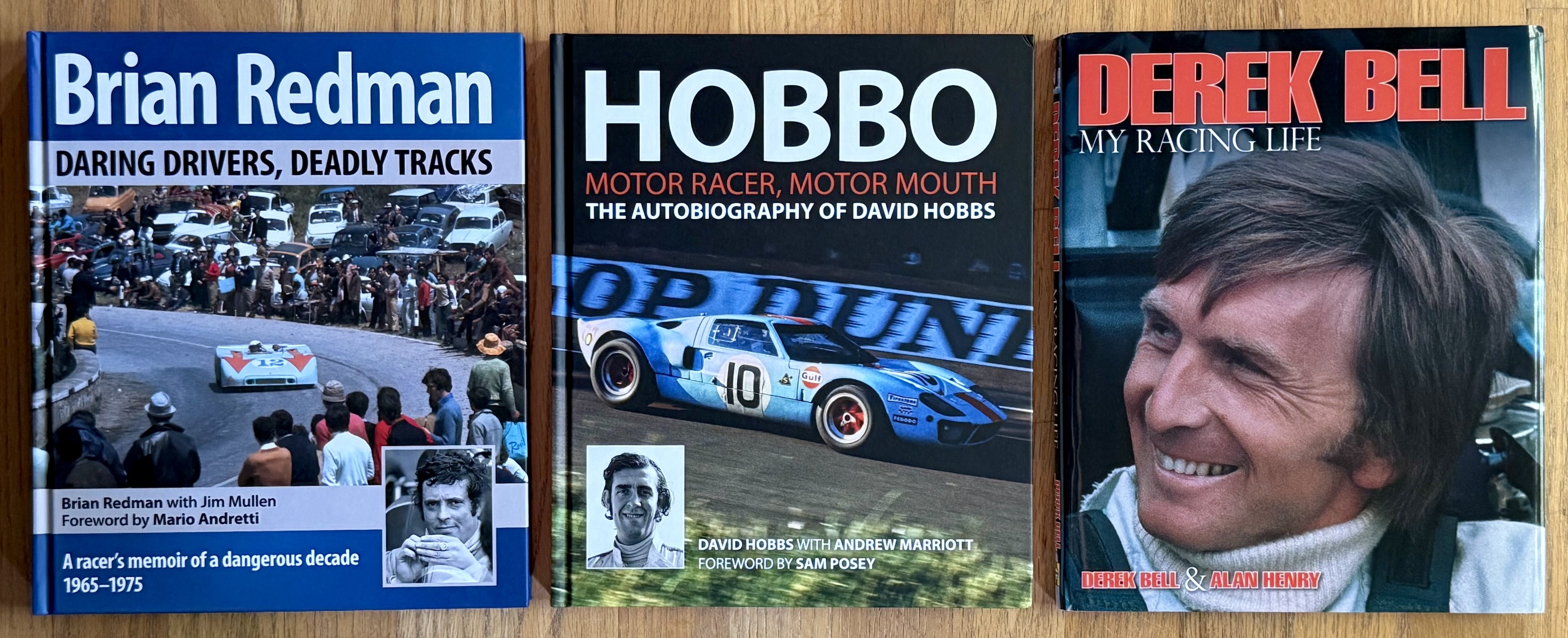
Brian Redman: Daring Drivers, Deadly Tracks: A racer’s memoir of a dangerous decade 1965-1975

By Brian Redman with Jim Mullen, Forward by Mario Andretti, Evro Publishing (2016), 300 pages, hardback

HOBBO: Motor racer, Motor Mouth: The Autobiography of David Hobbs

By David Hobbs with Andrew Marriott, Forward by Sam Posey, Evro Publishing (2018), 304 pages, hardback

Derek Bell: My Racing Life

By Derek Bell & Alan Henry, Haynes Publishing (2011), 272 pages, hardback

For the month of August, I’ve featured books written by three of my all-time favorite British drivers, Brian Redman, David Hobbs, and Derek Bell. Each one enjoyed success in a variety of racing series, from open wheel formulas to endurance sports cars. They’re also known for their unique style of storytelling, which paints an intriguing and entertaining picture of life in the world of auto racing in the 1960’s, 70’s, and 80’s.

These are highly valued books in my collection, so I was keen to have each one signed by them, in person. I met Brian Redman while covering a Vintage Racer Group (VRG) event at Summit Point in 2019. He served as the Grand Marshal that weekend, which was highlighted by a dinner in which he spoke and kept us all enthralled with his tales of driving for the factory Ferrari and Porsche teams. When I met up with him to have the book signed, I asked about his experiences with the filming of Steve McQueen’s movie, Le Mans. He and many drivers that year assisted with filming sequences in the weeks after the race was completed. Brian noted that McQueen was a very talented driver and could have made a very successful career for himself had he chose to pursue it full time.

I met David Hobbs at Watkins Glen during the 2018 SVRA United States Vintage Grand Prix. He too served as the Grand Marshal for the event. In between his ceremonial duties he had set-up a stand in the paddock amongst the other merchandise vendors. I made sure I was first in line and was able to have a brief chat with him. I told him my first time seeing him race was at The Glen in 1973 when he drove the Carling Black Label McLaren in the Can-Am Series. That’s also when I first saw Brian Redman race as well. David’s book also includes a section that covers his lengthy broadcasting career. He was without doubt my favorite color-analyst in racing, for his unique perspective having been a driver, but also for his wit and warmth.

Finally, I met Derek Bell at the 60th running of the 12 Hours of Sebring in 2012. This race was special because it was the first ever race for the newly established World Endurance Championship (WEC), which ran their race simultaneously with the IMSA teams. It was a bit chaotic for score keepers who were tracking the overall winner, the WEC race leaders, and the IMSA leaders. Sometime during the mid-afternoon, I was able to find the location where Derek was signing his book. He too was very gracious and generous with his time, as I was able to have a brief chat with him. He’s best known for his career with Porsche and his five wins at the 24 Hours of Le Mans, and three wins at the 24 Hours of Daytona.

All three books include beautiful black & white and color photographs, chronicling the careers of each driver. The variety of cars they drove is staggering compared to today’s racing culture where drivers seem to be pigeon-holed into their respective series. It seems extremely noteworthy these days when a driver hops to another series and drives a race. At one time that was an accepted and encouraged practice.

I highly recommend each of these books for your auto racing book collections. I consider their era of racing the best that’s ever been. Enjoy.

TJ…..2025

Posted in Auto Racing, Auto Racing History, Book Review, Motor Racing, Writing | Tagged , , , , , , | 1 Comment

TJ’s Racing Bookshelf: July 2025

Autocourse/Driver Profiles Vol. 5Emerson Fittipaldi

By Gordon Kirby, Hazelton Publishing (1990), 107 pages, hardback

Autocourse/Driver Profiles Vol. 3Alain Prost

By Nigel Roebuck, Hazelton Publishing (1990), 109 pages, hardback

We’re already halfway through 2025 and for the month of July I’ve featured another selection of driver profiles. During one of my many visits to used bookstores and antiques shops I came across two volumes of the AUTOCOURSE Driver Profile series, featuring Emerson Fittipaldi and Alain Prost. Both are on my short list of all-time favorite drivers. 

What makes these books even more special is that they are written by two highly acclaimed auto racing journalists. First, Gordon Kircby is the author of the Emerson Fittipaldi volume, while Nigel Roebuck has written about Alain Prost. Each author are experts in their field and are uniquely versed in communicating the intricacies of Formula 1 and of IndyCar. Each volume consists of direct quotes from the drivers drawn from in-depth interviews.

Both volumes were released in 1990, before each of the drivers had completed their respective careers. Which is ok by me, because this then represents a real time snapshot of the drivers while they are still active and highly competitive. Emerson Fittipaldi won two Formula 1 World Championships (1972 and 1974), along with an IndyCar (CART) Championship (1989). He won two Indianapolis 500 races (1989, 1993), the second being after the book was published. Alain Prost won four Formula 1 Championships (1985, 1986, 1989, and 1993), the final one also occurring after the book was released.

Each volume contains an abundance of photographs from all stages of their careers and includes detailed race result statistics at the rear of each book. These are entertaining and concise accounts of two truly amazing drivers. I’m on the lookout for the other titles in this series, spotlighting drivers such as Niki Lauda, Gilles Villeneuve, Jochen Rindt, Nelson Piquet, Jim Clark, Graham Hill, Ayrton Senna, and Nigel Mansell. I highly recommend this series to any racing fan.

TJ…..2025

Posted in Auto Racing History, Book Review, Books, F1, IndyCar, Writing | Tagged , , , , | 1 Comment

TJ’s Racing Bookshelf: June 2025

Jochen Rindt: Uncrowned King of Formula 1

By David Tremayne, Evro Publishing, 496 pages, paperback

Stirling Moss: The Authorized Biography

By Robert Edwards , Orion Publishing Co., 266 pages, paperback

James Hunt: The Biography

By Gerald Donaldson, Virgin Books, 400 pages, paperback

For the month of June, I’ve selected a variety of Formula 1 related biographies. This in advance of the highly anticipated Brad Pitt ‘F1’ movie, which is soon to be released, having had over a year’s worth of build-up and promotion. We’ll soon see if it was worth the wait. But will it be a true reflection of Formula 1, in an historical sense, or just a snapshot of the current iteration that is full of artificial glitz and glamour, with drivers endlessly whining on the radio?

Maybe now is the perfect time to step back and revisit Formula 1 in its early years. ‘The Golden Age’. A time that called upon a driver’s skill, daring, and bravery to navigate extremely dangerous tracks in cars that did not include all the safety advancements we now take for granted.

The technology surrounding the sport has obviously progressed throughout the years, but I contend the quality of driving has not. ‘Back in the day’ the connection a driver had with his race car while at speed was pure, and without outside assistance or manipulation. Simply said the drivers in the early years of F1 were ‘as one with the car’ to a greater degree than in today’s era. For a driver to stand above their peers in the 50’s, 60’s, 70’s, etc. was a sign that they were an extra special breed.

Jochen Rindt holds the unique and sad distinction of being the only Formula One Champion to be crowned posthumously, in 1970, after losing his life in the Italian Grand Prix. Known for his incredible car-control, Rindt had become a force to be reckoned with in the late 60’s driving for the Lotus team under Colin Chapman. This wonderful book tells his story, along with giving us (the reader) a glimpse of the Formula 1 Grand Prix world at the time.

Stirling Moss holds the distinction of being known as the greatest Grand Prix driver never to have won a championship. Driving in an era with the legendary Juan Manuel Fangio, who many believe is the greatest driver of all-time, certainly kept Moss from achieving that elusive championship. But he was known for his versatility, being a renowned sports car driver as well. This book chronicles the amazing racing life of a driver who became an international star, and who in later life was known as ‘Sir Stirling Moss’.

Many believe James Hunt holds the distinction of being the ultimate Formula 1 playboy. As you’ll read in the book, he led a life outside the car that was just as fast and freewheeling as his driving style. He was charismatic and his presence was larger than life. His story is closely linked with that of Niki Lauda and their battle for the championship in 1976. The movie ‘RUSH’, released in 2013, focused on their epic battle for the F1 title. This book goes into greater detail of that period but also sheds light on Hunt’s overall incredible, yet short career.

Formula 1 has grown in popularity over the past few years and has brought in a whole new fan base. Many of whom I fear have no sense of history and are unaware of the great drivers, teams, and rivalries that had come before. I highly recommend any F1 fan to look at these books, and others, and learn about the history of F1 and it’s memorable personalities. For these are the shoulders that today’s stars stand upon. Enjoy!

TJ…..2025

Posted in Auto Racing, Auto Racing History, F1, Grand Prix, Writing | Tagged , , , , , , , | Leave a comment

Vintage Racer Group/VRG Jefferson 500 @ Summit Point

Summit Point Motorsports Park, Summit Point, WV – May 16-18, 2025

Victory Lane Magazine, June 2025: Volume 40, No. 6

Story by Terry Johnsen

The racing season is now well-underway and seems to shift into high gear once the month of May rolls around. The ‘need for speed’ is in the air. For vintage racers there’s one event that satisfies the soul like no other and that is the Vintage Racer Group (VRG) Jefferson 500 at Summit Point Motorsports Park, located in the beautiful rolling hills of West Virginia, just west of Charlestown. The Summit Point circuit first opened in 1969, and features a 10 turn, 2-mile layout, featuring a 2,900-foot main straight and a tricky corner combination of turns 5-8 known as The Carousel. It has a little bit of everything, and a lot of excitement.

As always, the Jefferson 500 schedule is jam packed with activities beginning on Tuesday, which is load-in day and a mandatory classroom session in the afternoon for students enrolled in their Licensing School. Class officially starts on Wednesday and runs through the following day when practice sessions begin in the afternoon. Thursday afternoon culminates with a detailed and informative track walk. Friday is when the real fun begins. Timed qualifying sessions for all groups take place before the noon lunchtime break, with the first sprint races in the afternoon. Saturday sees each group participate in morning sprints, with the afternoon dedicated to their feature races. Sunday begins with one last round of sprint races for each group, leaving the afternoon for two all-comers sprints. The first being for closed-wheel cars and the second dedicated to open wheel cars. By the end of this schedule each driver, each set of groups, would have experienced an incredible amount of track time. One of VRG’s cornerstone attributes.

VRG’s race groups are designated as follows: Group 1 (Wyer Cup, IMSA RS/SCCA 2.5 Reunion), Group 2 (Cunningham Cup, Big Bore), Group 3 (Marlboro Cup, Small Bore over 1.3L), Group 4 (Lola Cup, Small Bore under 1.3L & Formula Vee), Group 5 (Donohue Cup, Production & Special through ’60), Group 6 (Charlie Gibson Trophy, Sports Racers), and Group 7 (Phil Hill Cup, Formula Ford Challenge Series). There were just over 235 entries for this year’s Jefferson 500. Another year of incredible response and turn-out.

Group 1 provided some compelling races throughout the weekend. In particular, the feature race was boiling down to a last lap showdown between race winner Matt Sturgeon (#3 – 1981 Volkswagen Scirocco) and Steve Byrne (#3 – 1970 Datsun 510). These two were pitted in a close battle throughout the race with each sharing the lead for a number of laps. As the race approached its conclusion, Bryne went off track and his race was over. Sturgeon took the win, with Mike Kelley (#86 – 1986 Volkswagen Golf GTI) in second, and Stephen LeBrun (#137 – 1974 Ford Escort Mk1 RS1600) in third. Mike Kelley (#86) enjoyed an impressive weekend with a win in the Saturday morning sprint and two second place finishes.

Late Friday afternoon, the first sprint race of the weekend for Group 2 was postponed until Saturday morning due to inclement weather and reports of lightning in the area. The wait was worth it though because this turned out to be a nail-biter. Chris Zappa (#4 – 1972 Datsun 240Z/2.8L) and Clarke Ohrstrom (#72 – 1971 BMW 3.0 CSL) battled nose-to-tail throughout the race. Ohrstrom had the lead after lap 1, with Zappa passing and leading after lap 2. Ohrstrom then retook the lead and held it until lap 7, at which time Zappa once again passed him and held on for a thrilling finish. Zappa also won the Saturday feature race with Ohrstrom taking honors in the Sunday sprint.

Group 3 proved to be a three man show, with Henry Frye (#29 – 1968 Triumph TR250) and Lenny Stann (#894 – 1970 Porsche 911) battling for the lead in each of the weekend’s four sprint races. Frye won the Friday sprint, finished second in the Saturday sprint, and won the Saturday feature and Sunday sprint race. Stann won the Saturday morning sprint and finished second to Frye in the other races. Each of the races were close and competitive battles. David Gott (#80 – 1962 Triumph TR4) took third place honors in each of the races behind Frye and Stann.

Robert Andersson (#78 – 1970 Vitesse Sports Racer) won everything there was to win in Group 4. He captured each race with comfortable finishing margins and took the fastest lap honors as well. Thomas V.G. Brown (#1 – 1964 Triumph Spitfire) had a strong showing with a third-place finish in Friday’s sprint, and second place finishes in the Saturday feature and Sunday sprint. Peter Carroll (#55 – 1963 Austin Healey Sprite) made his presence felt while lurking behind the front-runners, taking three third place finishes.

The Group 5 feature race on Saturday afternoon saw an incredible finish, when Tom Upshur (#4 – 1962 Lotus 7) chased down Hervey Parke (#11 – 1965 Ginetta G4) and passed him on the last lap. This after clawing back Parke’s huge lead, lap by lap, then making his move in the end. But don’t feel too bad for Hervey Parke, for he won the Friday and Sunday sprint races, along with finishing third in the Saturday morning sprint. Not too bad. 

Joey Selmants (#15 – 1987 Swift DB2) had a fantastic weekend in Group 6 competition. He was a dominant force taking wins in the Friday and Saturday sprints, and the Saturday feature race. He did not participate in the Sunday sprint. Erik Skibsrud (#8 – 1972 Chevron B21) won the Sunday sprint in his beautiful red Chevron, with Canon livery.

Group 7 split their cars into groups 7a and 7b for the Friday sprint and Saturday feature races. Group 7 was combined for the Saturday morning sprint and Sunday sprint. Group 7a was dominated by Patrick Flynn (#29 – 1981 Van Diemen RF81). The Friday afternoon sprint race was incredibly intense, with Flynn in a heated battle with Dave Handy (#59 – 1978 Crossle 32F). Those two swapped the lead multiple times beginning on lap 9 through to lap 14, when Handy, in the lead, briefly went off track and opened the door for Flynn. Handy finished fourth. Patrick Flynn also won the Saturday feature race. Group 7b was a mixed bag of results, but still exciting and very competitive. The Friday sprint was black flagged just as the green flag flew. Two cars touched wheels, with Glenn Brooks (#82 – 1981 PRS RH-02) getting airborne for a moment before coming back down on all four wheels. Multiple cars scattered because of this and had to be attended to and removed before the action was restarted. All drivers were safe and sound. Once the race resumed Taras Pawluczkowycz (#177 – 1971 Royale RP3A) was the eventual winner. Ira Nesbitt (#555 – 1981 Windshadow Club Ford) won the Saturday feature race. 

The combined Group 7 races were super competitive beginning with the Saturday morning sprint where the front six cars got a little too excited and were all penalized for jumping the start. The eventual winner taking the checkered flag was Doug Meis (#27 – 1974 Lola T340). He was closely followed in tow by Eric Langbein (#4 – 1971 March 719) and Robert Dusek III (#23 – 1970 Winkelman WDF2), finishing second and third respectively. The Sunday sprint race was hotly contested at the front by Scott Fairchild (#120 – 1978 Zink Z10) and eventual winner Jacob King (#3 – 1977 Royale RP24). Fairchild hounded King lap after lap, always testing him by pulling out to attempt a pass down the front straight. He eventually succeeded and took the lead on the penultimate lap but couldn’t hold on. This was just another example of the passion and love for racing these drivers share with each other. It was pure clean racing.

The weekend’s activities came to an end with the running of the two all-comers races. The closed wheel only (Groups 1-6) race was an absolute runaway by Gary Hagopian (#131h – 1963 Jaguar XKE Coupe). His beautiful red Jag stormed into the distance, leaving the rest of the field behind. It was a commanding win. The open wheel only (Groups 6-7) race began as a close contest between several cars, but eventually Andrew Graham (#7 – 1986 Van Diemen 1600) pulled away and won by a considerable margin.

After the last lap was run and the competitors were packing up their gear in the paddock, I was able to speak briefly with Jim Karamanis, VRG’s Jefferson 500 co-coordinator. Jim began by saying it had been a very successful week. He noted “we had great weather Wednesday for the school. Practice Thursday was great, and Friday the weather was fantastic until the very end of the day.” Due to lightning lingering in the area the final two sprints were postponed till Saturday morning. Jim added “we were able to rejigger the schedule for Saturday to front load those races, then proceeded with the regularly planned schedule.” In all, the track was active from 8:15am to 6pm. Jim said “the track was very generous in expanding their window, plus shortening the lunch break slightly, we made it happen. Everyone got their track time, no one missed a session.” While speaking with Jim at least four competitors stopped by to offer their thanks and appreciation for a great event. One asked if he could offer a suggestion, which had to do with the order that groups run and shared his reasons. Afterwards Jim noted to me that a survey is sent out after each event. They read every suggestion sent in and try to employ those where possible, adding “we focus on what our members want.” As an example, he said, “we did away with the Sunday enduros because the general population of members preferred another round of sprints.” He also said that VRG now has live stream coverage of all the races, with commentary, on their YouTube channel (https://www.youtube.com/@VintageRacerGroup). There are multiple cameras placed all around the track. He said, “it’s been very well received.” Finally, he summed up his thoughts on the event by saying, “overall people were happy, polite, appreciative. It means a lot that people go out of their way to share their thoughts and thanks. This group feels like a family.” I couldn’t agree more.

This was definitely a weekend well-spent. The Vintage Racer Group (VRG) Jefferson 500 always delivers and has that knack to ‘satisfy the soul’ for all racing enthusiasts. If you’ve never been to one, mark your calendar for May 2026. It’s like spending a race weekend with family. 

The end. 

TJ – 2025

Posted in Auto Racing, Summit Point Motorsports Park, Victory Lane Magazine, Vintage Racing, Writing | Tagged , , , , | Leave a comment

TJ’s Racing Bookshelf: May 2025

Indianapolis 500 Official Programs; 1980, 1981, 1982, and 1983

Publisher: Indianapolis Motor Speedway Corporation

It’s the month of May and that means one thing to an auto racing fan, The Indianapolis 500. It is truly the “Greatest Spectacle in Racing”. My first trips to the Indy 500 were during a four-year span from 1980-1983. I was blown away by the sheer size of the venue and pageantry of the event. It is second to none. And, like any racing event I attend I always purchase the program. It captures a moment in history and is filled with facts and figures leading up to the race, along with acting as a time capsule of sorts with advertisements and nostalgic imagery. One feature that is a special keepsake in each of the Indy 500 programs is a foldout poster of the starting grid, featuring all the drivers in their cars taken for their official race portrait.

My first race was in 1980 and was won by Johnny Rutherford in the classic ‘yellow’ Pennzoil Chaparral. He became a three-time winner that day, having previously won the race in 1974 and 1976. Rutherford had early battles for the lead with a variety of legendary drivers to include Bobby Unser, Mario Andretti, Rick Mears and Tom Sneva. But in the final stages of the race Rutherford began to pull away and won the race in a comfortable and commanding fashion. 

In 1981 the race boiled down to a battle between Bobby Unser and Mario Andretti. Unser took the checkered flag and participated in the post-race celebrations, but it was just the start of the controversy that lasted several months. In the closing stages of the race, Unser appeared to reenter the track after a pitstop in a manner that was against the rules, passing cars following the safety car rather than blending in where appropriate. Andretti exited right behind Unser following the rules of reengagement. But now when the green flag restarted the race, rather than being right behind Unser, Andretti first had to pass multiple cars, working his way to the front. He ran out of time and finished second. Afterwards the sanctioning body USAC imposed a penalty on Unser and awarded Andretti first place. Roger Penke (Unser’s owner) filed an appeal which ultimately overturned the penalty and awarded Unser the win, but not until October 8th that year.

1982 was to be Mario’s chance to reclaim the win he thought he rightfully deserved. But his day proved to end even before it began. As the field of 33 cars approached the start/finish to begin the race, Kevin Cogan, sitting in the middle of the front row, spun his wheels losing control of the car, hitting AJ Foyt’s car and then completely damaging Andretti’s car, putting him out of the race. Once the clean-up was finished the race proved to be fast and entertaining, leading up to the most fantastic finish the 500 had ever seen. After the final pit stops, the leader was Andretti’s teammate Gordon Johncock, holding a lead of about 11 seconds. Penske driver Rick Mears then started his charge to the front, taking almost one second off Johncock’s lead each lap. They passed the start/finish line to begin the last lap side by side. You could hear the roar of the crowd over the sound of the cars. Driving an ill-handling car at this stage of the race Johncock held for his second 500 win by just 0.16 seconds.

The running of the 1983 Indianapolis 500 was won by Tom Sneva, driving his Texaco Star March. After having finished second three times, this was finally his moment. But not without a final challenge to overcome. In the closing laps the leader was Al Unser Sr. with Sneva is second. But as Sneva attempted to pass a lapped car driven by Unser Jr., ‘Little Al’ appeared to be running interference for his dad, slowing Sneva’s pace. More lapped traffic ahead allowed Sneva to get around Unser Jr., and in short order Sneva was able to catch and pass Unser Sr., ultimately taking the checkered flag by 11.174 seconds.

These programs are a prized possession in my collection, providing special memories, and bringing an era of Indy 500 ‘glory years’ back to life. Enjoy!

TJ…..2025

Posted in Auto Racing History, Book Review, Indianapolis 500, IndyCar, Writing | Tagged , , , , , | 1 Comment