By Gordon Kirby, Hazelton Publishing (1990), 107 pages, hardback
Autocourse/Driver Profiles Vol. 3 – Alain Prost
By Nigel Roebuck, Hazelton Publishing (1990), 109 pages, hardback
We’re already halfway through 2025 and for the month of July I’ve featured another selection of driver profiles. During one of my many visits to used bookstores and antiques shops I came across two volumes of the AUTOCOURSE Driver Profile series, featuring Emerson Fittipaldi and Alain Prost. Both are on my short list of all-time favorite drivers.
What makes these books even more special is that they are written by two highly acclaimed auto racing journalists. First, Gordon Kircby is the author of the Emerson Fittipaldi volume, while Nigel Roebuck has written about Alain Prost. Each author are experts in their field and are uniquely versed in communicating the intricacies of Formula 1 and of IndyCar. Each volume consists of direct quotes from the drivers drawn from in-depth interviews.
Both volumes were released in 1990, before each of the drivers had completed their respective careers. Which is ok by me, because this then represents a real time snapshot of the drivers while they are still active and highly competitive. Emerson Fittipaldi won two Formula 1 World Championships (1972 and 1974), along with an IndyCar (CART) Championship (1989). He won two Indianapolis 500 races (1989, 1993), the second being after the book was published. Alain Prost won four Formula 1 Championships (1985, 1986, 1989, and 1993), the final one also occurring after the book was released.
Each volume contains an abundance of photographs from all stages of their careers and includes detailed race result statistics at the rear of each book. These are entertaining and concise accounts of two truly amazing drivers. I’m on the lookout for the other titles in this series, spotlighting drivers such as Niki Lauda, Gilles Villeneuve, Jochen Rindt, Nelson Piquet, Jim Clark, Graham Hill, Ayrton Senna, and Nigel Mansell. I highly recommend this series to any racing fan.
By David Tremayne, Evro Publishing, 496 pages, paperback
Stirling Moss: The Authorized Biography
By Robert Edwards , Orion Publishing Co., 266 pages, paperback
James Hunt: The Biography
By Gerald Donaldson, Virgin Books, 400 pages, paperback
For the month of June, I’ve selected a variety of Formula 1 related biographies. This in advance of the highly anticipated Brad Pitt ‘F1’ movie, which is soon to be released, having had over a year’s worth of build-up and promotion. We’ll soon see if it was worth the wait. But will it be a true reflection of Formula 1, in an historical sense, or just a snapshot of the current iteration that is full of artificial glitz and glamour, with drivers endlessly whining on the radio?
Maybe now is the perfect time to step back and revisit Formula 1 in its early years. ‘The Golden Age’. A time that called upon a driver’s skill, daring, and bravery to navigate extremely dangerous tracks in cars that did not include all the safety advancements we now take for granted.
The technology surrounding the sport has obviously progressed throughout the years, but I contend the quality of driving has not. ‘Back in the day’ the connection a driver had with his race car while at speed was pure, and without outside assistance or manipulation. Simply said the drivers in the early years of F1 were ‘as one with the car’ to a greater degree than in today’s era. For a driver to stand above their peers in the 50’s, 60’s, 70’s, etc. was a sign that they were an extra special breed.
Jochen Rindt holds the unique and sad distinction of being the only Formula One Champion to be crowned posthumously, in 1970, after losing his life in the Italian Grand Prix. Known for his incredible car-control, Rindt had become a force to be reckoned with in the late 60’s driving for the Lotus team under Colin Chapman. This wonderful book tells his story, along with giving us (the reader) a glimpse of the Formula 1 Grand Prix world at the time.
Stirling Moss holds the distinction of being known as the greatest Grand Prix driver never to have won a championship. Driving in an era with the legendary Juan Manuel Fangio, who many believe is the greatest driver of all-time, certainly kept Moss from achieving that elusive championship. But he was known for his versatility, being a renowned sports car driver as well. This book chronicles the amazing racing life of a driver who became an international star, and who in later life was known as ‘Sir Stirling Moss’.
Many believe James Hunt holds the distinction of being the ultimate Formula 1 playboy. As you’ll read in the book, he led a life outside the car that was just as fast and freewheeling as his driving style. He was charismatic and his presence was larger than life. His story is closely linked with that of Niki Lauda and their battle for the championship in 1976. The movie ‘RUSH’, released in 2013, focused on their epic battle for the F1 title. This book goes into greater detail of that period but also sheds light on Hunt’s overall incredible, yet short career.
Formula 1 has grown in popularity over the past few years and has brought in a whole new fan base. Many of whom I fear have no sense of history and are unaware of the great drivers, teams, and rivalries that had come before. I highly recommend any F1 fan to look at these books, and others, and learn about the history of F1 and it’s memorable personalities. For these are the shoulders that today’s stars stand upon. Enjoy!
Summit Point Motorsports Park, Summit Point, WV – May 16-18, 2025
Victory Lane Magazine, June 2025: Volume 40, No. 6
Story by Terry Johnsen
The racing season is now well-underway and seems to shift into high gear once the month of May rolls around. The ‘need for speed’ is in the air. For vintage racers there’s one event that satisfies the soul like no other and that is the Vintage Racer Group (VRG) Jefferson 500 at Summit Point Motorsports Park, located in the beautiful rolling hills of West Virginia, just west of Charlestown. The Summit Point circuit first opened in 1969, and features a 10 turn, 2-mile layout, featuring a 2,900-foot main straight and a tricky corner combination of turns 5-8 known as The Carousel. It has a little bit of everything, and a lot of excitement.
As always, the Jefferson 500 schedule is jam packed with activities beginning on Tuesday, which is load-in day and a mandatory classroom session in the afternoon for students enrolled in their Licensing School. Class officially starts on Wednesday and runs through the following day when practice sessions begin in the afternoon. Thursday afternoon culminates with a detailed and informative track walk. Friday is when the real fun begins. Timed qualifying sessions for all groups take place before the noon lunchtime break, with the first sprint races in the afternoon. Saturday sees each group participate in morning sprints, with the afternoon dedicated to their feature races. Sunday begins with one last round of sprint races for each group, leaving the afternoon for two all-comers sprints. The first being for closed-wheel cars and the second dedicated to open wheel cars. By the end of this schedule each driver, each set of groups, would have experienced an incredible amount of track time. One of VRG’s cornerstone attributes.
VRG’s race groups are designated as follows: Group 1 (Wyer Cup, IMSA RS/SCCA 2.5 Reunion), Group 2 (Cunningham Cup, Big Bore), Group 3 (Marlboro Cup, Small Bore over 1.3L), Group 4 (Lola Cup, Small Bore under 1.3L & Formula Vee), Group 5 (Donohue Cup, Production & Special through ’60), Group 6 (Charlie Gibson Trophy, Sports Racers), and Group 7 (Phil Hill Cup, Formula Ford Challenge Series). There were just over 235 entries for this year’s Jefferson 500. Another year of incredible response and turn-out.
Group 1 provided some compelling races throughout the weekend. In particular, the feature race was boiling down to a last lap showdown between race winner Matt Sturgeon (#3 – 1981 Volkswagen Scirocco) and Steve Byrne (#3 – 1970 Datsun 510). These two were pitted in a close battle throughout the race with each sharing the lead for a number of laps. As the race approached its conclusion, Bryne went off track and his race was over. Sturgeon took the win, with Mike Kelley (#86 – 1986 Volkswagen Golf GTI) in second, and Stephen LeBrun (#137 – 1974 Ford Escort Mk1 RS1600) in third. Mike Kelley (#86) enjoyed an impressive weekend with a win in the Saturday morning sprint and two second place finishes.
Late Friday afternoon, the first sprint race of the weekend for Group 2 was postponed until Saturday morning due to inclement weather and reports of lightning in the area. The wait was worth it though because this turned out to be a nail-biter. Chris Zappa (#4 – 1972 Datsun 240Z/2.8L) and Clarke Ohrstrom (#72 – 1971 BMW 3.0 CSL) battled nose-to-tail throughout the race. Ohrstrom had the lead after lap 1, with Zappa passing and leading after lap 2. Ohrstrom then retook the lead and held it until lap 7, at which time Zappa once again passed him and held on for a thrilling finish. Zappa also won the Saturday feature race with Ohrstrom taking honors in the Sunday sprint.
Group 3 proved to be a three man show, with Henry Frye (#29 – 1968 Triumph TR250) and Lenny Stann (#894 – 1970 Porsche 911) battling for the lead in each of the weekend’s four sprint races. Frye won the Friday sprint, finished second in the Saturday sprint, and won the Saturday feature and Sunday sprint race. Stann won the Saturday morning sprint and finished second to Frye in the other races. Each of the races were close and competitive battles. David Gott (#80 – 1962 Triumph TR4) took third place honors in each of the races behind Frye and Stann.
Robert Andersson (#78 – 1970 Vitesse Sports Racer) won everything there was to win in Group 4. He captured each race with comfortable finishing margins and took the fastest lap honors as well. Thomas V.G. Brown (#1 – 1964 Triumph Spitfire) had a strong showing with a third-place finish in Friday’s sprint, and second place finishes in the Saturday feature and Sunday sprint. Peter Carroll (#55 – 1963 Austin Healey Sprite) made his presence felt while lurking behind the front-runners, taking three third place finishes.
The Group 5 feature race on Saturday afternoon saw an incredible finish, when Tom Upshur (#4 – 1962 Lotus 7) chased down Hervey Parke (#11 – 1965 Ginetta G4) and passed him on the last lap. This after clawing back Parke’s huge lead, lap by lap, then making his move in the end. But don’t feel too bad for Hervey Parke, for he won the Friday and Sunday sprint races, along with finishing third in the Saturday morning sprint. Not too bad.
Joey Selmants (#15 – 1987 Swift DB2) had a fantastic weekend in Group 6 competition. He was a dominant force taking wins in the Friday and Saturday sprints, and the Saturday feature race. He did not participate in the Sunday sprint. Erik Skibsrud (#8 – 1972 Chevron B21) won the Sunday sprint in his beautiful red Chevron, with Canon livery.
Group 7 split their cars into groups 7a and 7b for the Friday sprint and Saturday feature races. Group 7 was combined for the Saturday morning sprint and Sunday sprint. Group 7a was dominated by Patrick Flynn (#29 – 1981 Van Diemen RF81). The Friday afternoon sprint race was incredibly intense, with Flynn in a heated battle with Dave Handy (#59 – 1978 Crossle 32F). Those two swapped the lead multiple times beginning on lap 9 through to lap 14, when Handy, in the lead, briefly went off track and opened the door for Flynn. Handy finished fourth. Patrick Flynn also won the Saturday feature race. Group 7b was a mixed bag of results, but still exciting and very competitive. The Friday sprint was black flagged just as the green flag flew. Two cars touched wheels, with Glenn Brooks (#82 – 1981 PRS RH-02) getting airborne for a moment before coming back down on all four wheels. Multiple cars scattered because of this and had to be attended to and removed before the action was restarted. All drivers were safe and sound. Once the race resumed Taras Pawluczkowycz (#177 – 1971 Royale RP3A) was the eventual winner. Ira Nesbitt (#555 – 1981 Windshadow Club Ford) won the Saturday feature race.
The combined Group 7 races were super competitive beginning with the Saturday morning sprint where the front six cars got a little too excited and were all penalized for jumping the start. The eventual winner taking the checkered flag was Doug Meis (#27 – 1974 Lola T340). He was closely followed in tow by Eric Langbein (#4 – 1971 March 719) and Robert Dusek III (#23 – 1970 Winkelman WDF2), finishing second and third respectively. The Sunday sprint race was hotly contested at the front by Scott Fairchild (#120 – 1978 Zink Z10) and eventual winner Jacob King (#3 – 1977 Royale RP24). Fairchild hounded King lap after lap, always testing him by pulling out to attempt a pass down the front straight. He eventually succeeded and took the lead on the penultimate lap but couldn’t hold on. This was just another example of the passion and love for racing these drivers share with each other. It was pure clean racing.
The weekend’s activities came to an end with the running of the two all-comers races. The closed wheel only (Groups 1-6) race was an absolute runaway by Gary Hagopian (#131h – 1963 Jaguar XKE Coupe). His beautiful red Jag stormed into the distance, leaving the rest of the field behind. It was a commanding win. The open wheel only (Groups 6-7) race began as a close contest between several cars, but eventually Andrew Graham (#7 – 1986 Van Diemen 1600) pulled away and won by a considerable margin.
After the last lap was run and the competitors were packing up their gear in the paddock, I was able to speak briefly with Jim Karamanis, VRG’s Jefferson 500 co-coordinator. Jim began by saying it had been a very successful week. He noted “we had great weather Wednesday for the school. Practice Thursday was great, and Friday the weather was fantastic until the very end of the day.” Due to lightning lingering in the area the final two sprints were postponed till Saturday morning. Jim added “we were able to rejigger the schedule for Saturday to front load those races, then proceeded with the regularly planned schedule.” In all, the track was active from 8:15am to 6pm. Jim said “the track was very generous in expanding their window, plus shortening the lunch break slightly, we made it happen. Everyone got their track time, no one missed a session.” While speaking with Jim at least four competitors stopped by to offer their thanks and appreciation for a great event. One asked if he could offer a suggestion, which had to do with the order that groups run and shared his reasons. Afterwards Jim noted to me that a survey is sent out after each event. They read every suggestion sent in and try to employ those where possible, adding “we focus on what our members want.” As an example, he said, “we did away with the Sunday enduros because the general population of members preferred another round of sprints.” He also said that VRG now has live stream coverage of all the races, with commentary, on their YouTube channel (https://www.youtube.com/@VintageRacerGroup). There are multiple cameras placed all around the track. He said, “it’s been very well received.” Finally, he summed up his thoughts on the event by saying, “overall people were happy, polite, appreciative. It means a lot that people go out of their way to share their thoughts and thanks. This group feels like a family.” I couldn’t agree more.
This was definitely a weekend well-spent. The Vintage Racer Group (VRG) Jefferson 500 always delivers and has that knack to ‘satisfy the soul’ for all racing enthusiasts. If you’ve never been to one, mark your calendar for May 2026. It’s like spending a race weekend with family.
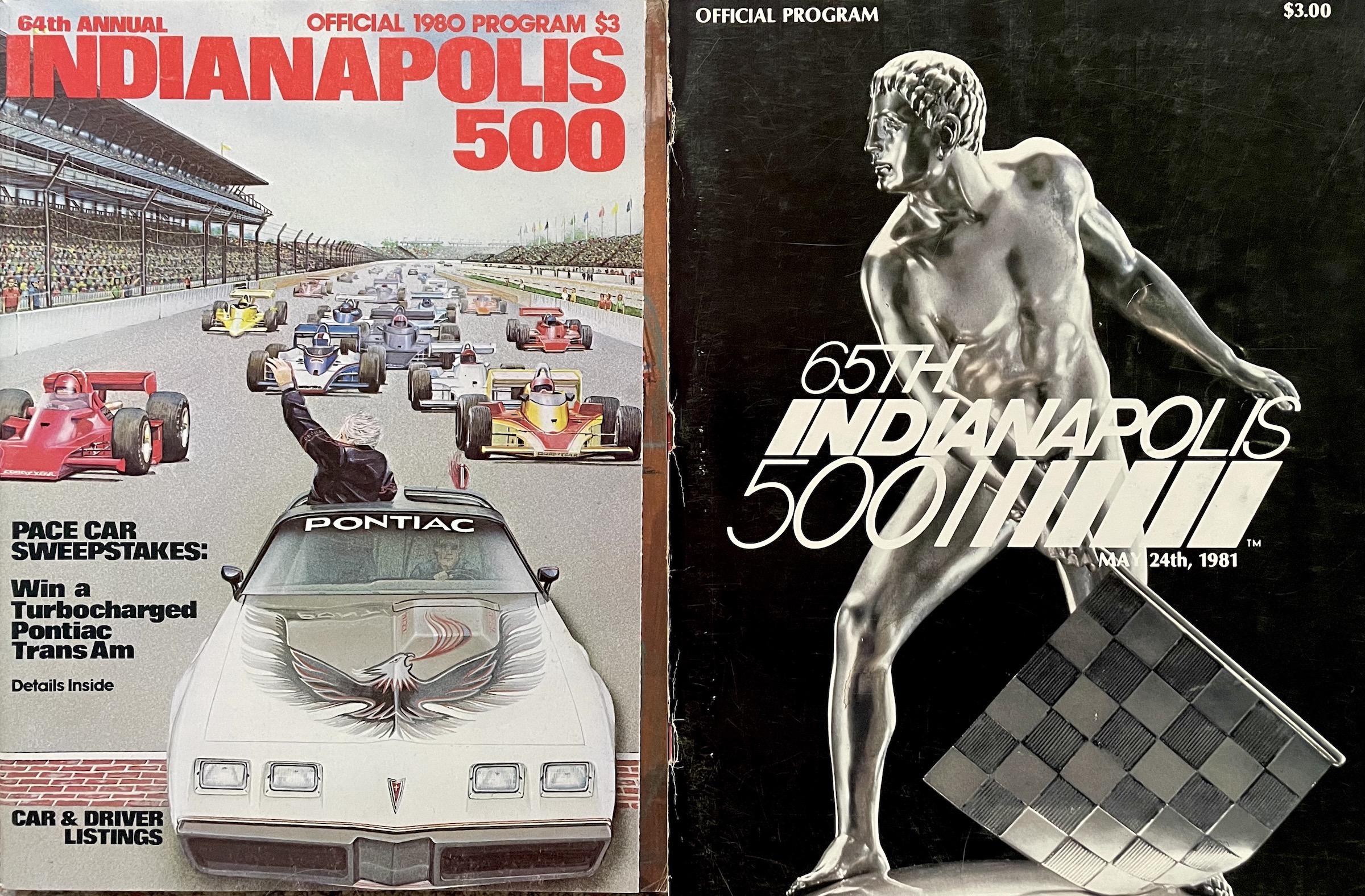
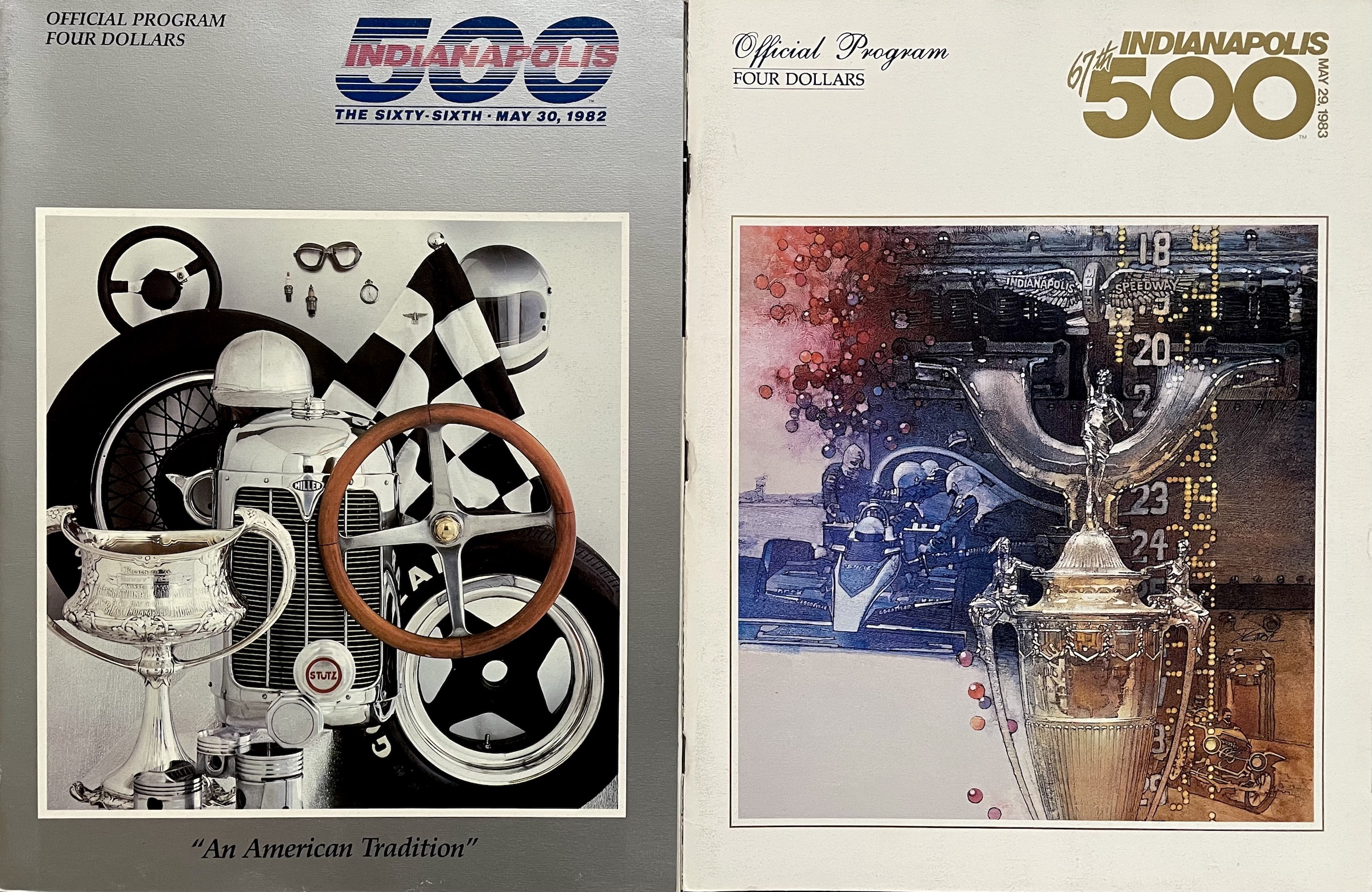
Indianapolis 500 Official Programs; 1980, 1981, 1982, and 1983
Publisher: Indianapolis Motor Speedway Corporation
It’s the month of May and that means one thing to an auto racing fan, The Indianapolis 500. It is truly the “Greatest Spectacle in Racing”. My first trips to the Indy 500 were during a four-year span from 1980-1983. I was blown away by the sheer size of the venue and pageantry of the event. It is second to none. And, like any racing event I attend I always purchase the program. It captures a moment in history and is filled with facts and figures leading up to the race, along with acting as a time capsule of sorts with advertisements and nostalgic imagery. One feature that is a special keepsake in each of the Indy 500 programs is a foldout poster of the starting grid, featuring all the drivers in their cars taken for their official race portrait.
My first race was in 1980 and was won by Johnny Rutherford in the classic ‘yellow’ Pennzoil Chaparral. He became a three-time winner that day, having previously won the race in 1974 and 1976. Rutherford had early battles for the lead with a variety of legendary drivers to include Bobby Unser, Mario Andretti, Rick Mears and Tom Sneva. But in the final stages of the race Rutherford began to pull away and won the race in a comfortable and commanding fashion.
In 1981 the race boiled down to a battle between Bobby Unser and Mario Andretti. Unser took the checkered flag and participated in the post-race celebrations, but it was just the start of the controversy that lasted several months. In the closing stages of the race, Unser appeared to reenter the track after a pitstop in a manner that was against the rules, passing cars following the safety car rather than blending in where appropriate. Andretti exited right behind Unser following the rules of reengagement. But now when the green flag restarted the race, rather than being right behind Unser, Andretti first had to pass multiple cars, working his way to the front. He ran out of time and finished second. Afterwards the sanctioning body USAC imposed a penalty on Unser and awarded Andretti first place. Roger Penke (Unser’s owner) filed an appeal which ultimately overturned the penalty and awarded Unser the win, but not until October 8th that year.
1982 was to be Mario’s chance to reclaim the win he thought he rightfully deserved. But his day proved to end even before it began. As the field of 33 cars approached the start/finish to begin the race, Kevin Cogan, sitting in the middle of the front row, spun his wheels losing control of the car, hitting AJ Foyt’s car and then completely damaging Andretti’s car, putting him out of the race. Once the clean-up was finished the race proved to be fast and entertaining, leading up to the most fantastic finish the 500 had ever seen. After the final pit stops, the leader was Andretti’s teammate Gordon Johncock, holding a lead of about 11 seconds. Penske driver Rick Mears then started his charge to the front, taking almost one second off Johncock’s lead each lap. They passed the start/finish line to begin the last lap side by side. You could hear the roar of the crowd over the sound of the cars. Driving an ill-handling car at this stage of the race Johncock held for his second 500 win by just 0.16 seconds.
The running of the 1983 Indianapolis 500 was won by Tom Sneva, driving his Texaco Star March. After having finished second three times, this was finally his moment. But not without a final challenge to overcome. In the closing laps the leader was Al Unser Sr. with Sneva is second. But as Sneva attempted to pass a lapped car driven by Unser Jr., ‘Little Al’ appeared to be running interference for his dad, slowing Sneva’s pace. More lapped traffic ahead allowed Sneva to get around Unser Jr., and in short order Sneva was able to catch and pass Unser Sr., ultimately taking the checkered flag by 11.174 seconds.
These programs are a prized possession in my collection, providing special memories, and bringing an era of Indy 500 ‘glory years’ back to life. Enjoy!
By: Steve Small; Publish Date: April 1994; Publisher: Guinness Publishing Ltd. (New York), Paperback, 416 pages
My book review for April is ‘The Guinness Complete Grand Prix Who’s Who’, by Steve Small. This is one of my favorite F1 history books, with regards to statistics and details into the individual record and accomplishments of Formula 1 drivers. The book is amazing. It includes ‘the career record of every driver to have started a World Championship race’, from 1950 through the 1993 season. Published in early 1994, it does not include a mention of contemporary champions such as Lewis Hamilton, Max Verstappen, Fernando Alonzo, Sebastian Vettel, Kimi Raikkonen, Nico Rosberg, Jenson Button or Jacques Villeneuve.
Michael Schumacher is listed, but his time with the Benneton team to this point (1993) had only garnered him 38 starts and two wins. His seven championships had not yet occurred. His first came in 1994 the year of this publication. Mika Hakkinen is listed, but at this time had only 33 starts and 0 wins. His two championships came in 1998 and 1999. So, one might ask does this diminish the value of the book? The answer is, ‘absolutely not’.
Because it’s ‘dated”, the advantage of having the book, from an historian’s perspective, is that it focuses on the generation of its time. If this book were published now, it would likely gloss over earlier periods and consolidate statistical details into short and concise bullet points. With this book I can look back at my favorite periods of Formula 1, the 50’s, 60’s, 70’s, and 80’s with an analytical eye and dive deep into the records of each race my favorite drivers competed in. You can then compare, contrast, and draw out some startling detail which paints a picture as to how dominant some of these drivers were.
Nowadays whenever a discussion takes place about who is the greatest F1 driver, the focus is on either Lewis Hamilton, Michael Schumacher, or Ayrton Senna. Their success is quite impressive, but with objective analysis their standing is overshadowed by the greatness of Juan Manuel Fangio. He captured Five World Championships, with 24 wins in just 51 grand prix starts, in an era that was inherently more dangerous. His winning percentage is a staggering 47%, against the likes of Stirling Moss, Alberto Ascari, Guiseppe Farina, and Mike Hawthorn. His dominance was complete.
My personal favorite F1 driver is Sir Jackie Stewart. I place him as a close second in the ‘best-ever’ conversation. He has three World Championships, including 27 wins in 99 starts, for an impressive 27% winning percentage. And he essentially retired ‘in his prime’. Along with his driving prowess, Stewart was a leading voice in the push for safety standards in Formula 1. He survived in an era that saw speeds dramatically increase, along with a staggering death toll. His mastery and understanding of a racecar allowed him to speak with authority in his post-racing career as an announcer for ABC’s Wide World of Sports.
‘The Guinness Complete Grand Prix Who’s Who’ is a must have for any Formula 1 fan. It’s a history lesson that tells the story through statistics, reflecting each period of the evolving world of Formula 1 Grand Prix racing. Look for it the next time you’re in your favorite ‘vintage’ book shop. I highly recommend it. Enjoy!
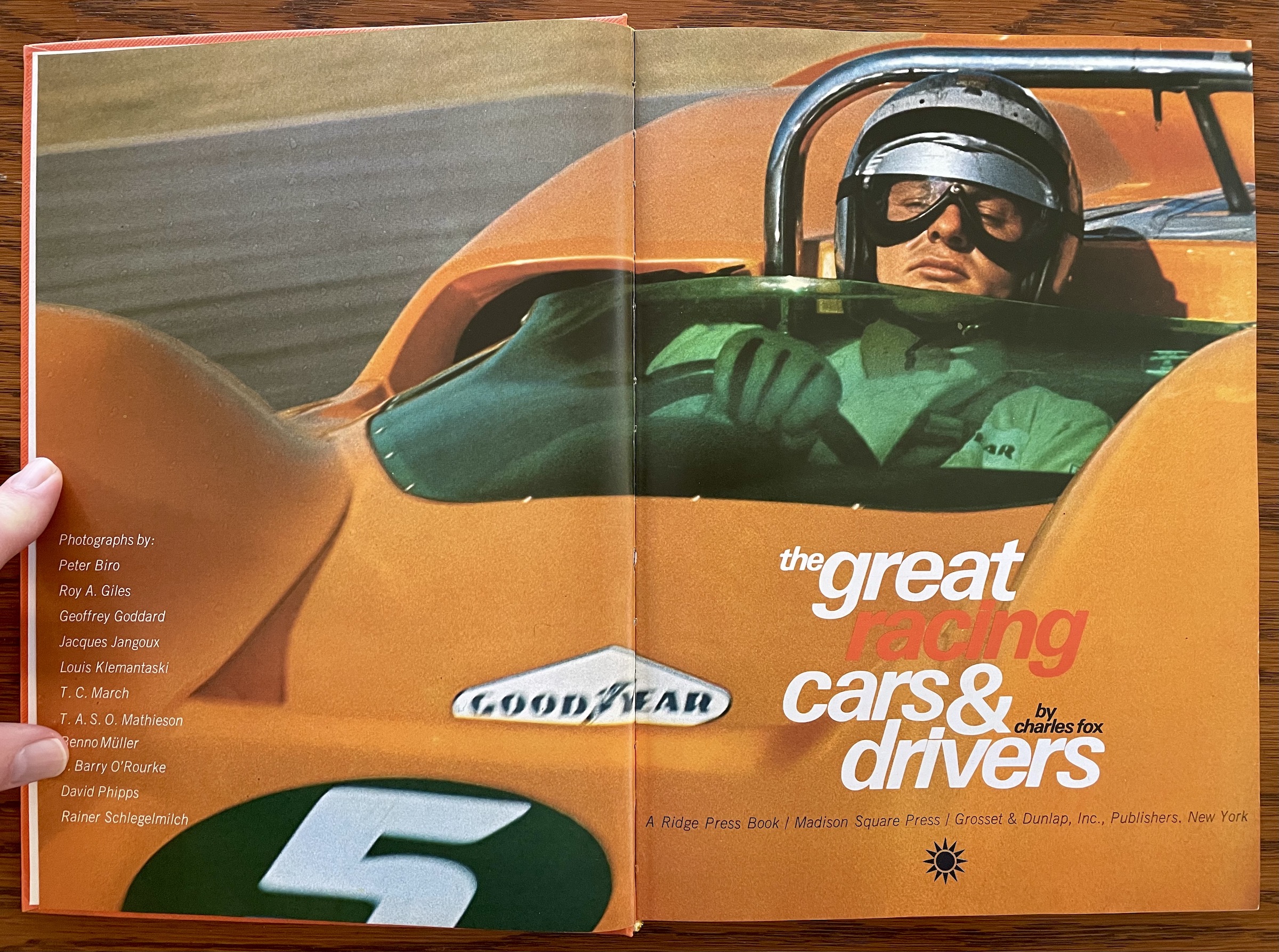
By: Charles Fox; Publish Date: January 1972; Publisher: Grosset & Dunlap, Publishers (New York), Hardcover, 252 pages
The third installment in my revived book review series is ‘The Great Racing Cars & Drivers’, by Charles Fox. This book really takes me back to my youth. I’ve lost track of how many times I had checked this out on loan from my local Akron (Ohio) library. It’s an interesting history of auto racing told in 12 chapters featuring notable pre-war grand prix greats, the evolution of Indianapolis cars, the spectacle of Le Mans, the modern era Can-Am cars, and notable personalities such as Bruce McLaren, Jim Clark, Jackie Stewart, Jochen Rindt, Jacky Ickx, and Graham Hill.
In 1972 when this book was released the only real time news from international racing available to me was via the phone line to the local Akron newspaper sports desk asking someone to check the news wire feed for Formula 1 or sports car results. It helped having a mother and uncle who worked for the paper. And then of course we had ABC’s Wide World of Sports on TV that would highlight major races such as the Monaco Grand Prix, the 24 Hours of Le Mans, and the Indianapolis 500. But it was books such as this that put the racing action into our hands with stunning and spectacular B&W and color photographs, featuring up close and personal images of the racing heroes of the day and their cars.
This copy was discovered at my favorite used bookstore, Second Story Books, located in Rockville, Maryland. I’m always in search for what I call “diamonds in the rough’. You can imagine the joy I felt when I saw the classic cover photo of Bruce McLaren. I was thrilled! (Note: included here is the double-page title spread, the same photo as used on the cover.) So, if you see one available, grab it. I highly recommend it. Enjoy!
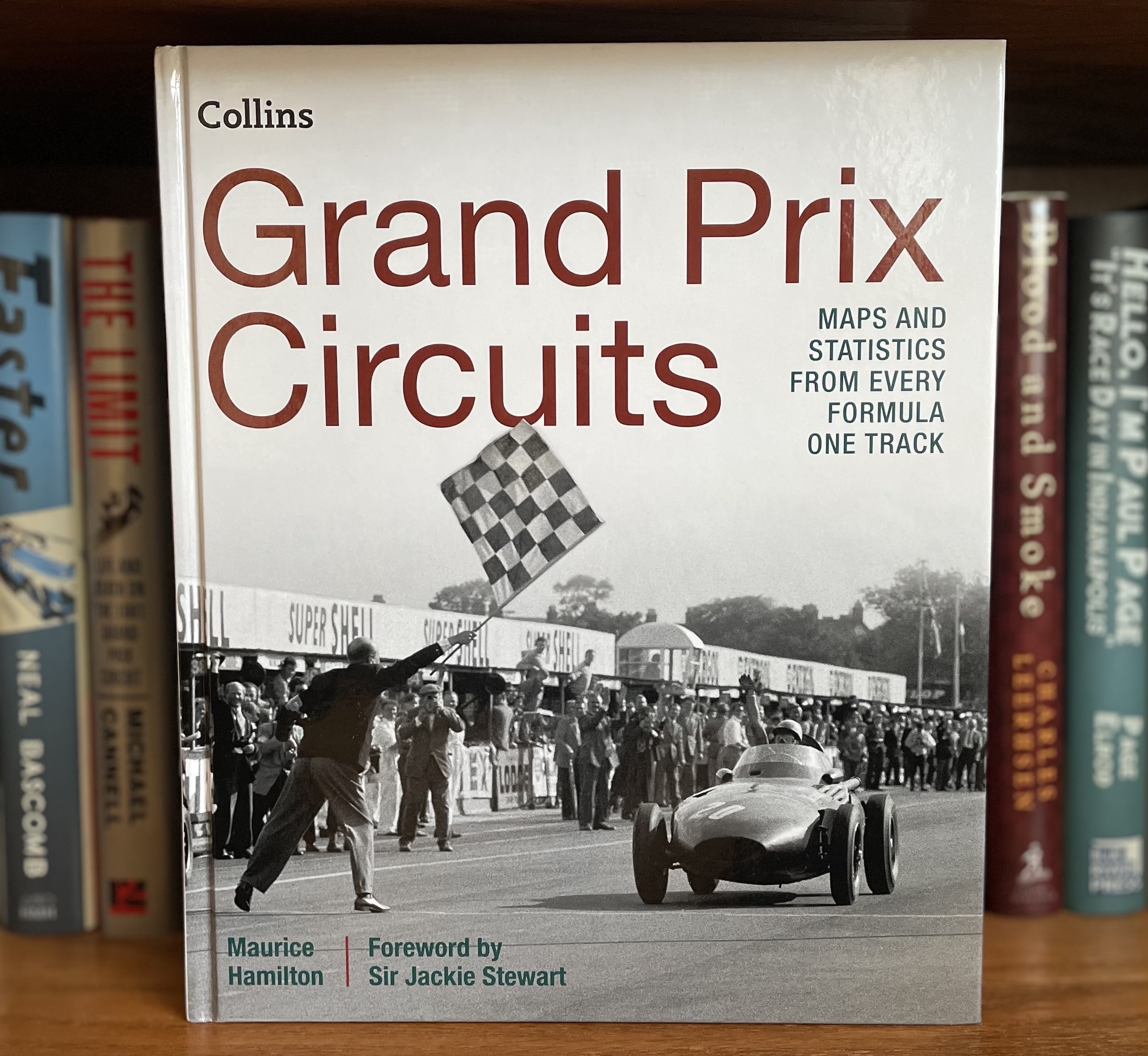
The second book I’d like to recommend in my revived book review series is ‘Grand Prix Circuits: Maps and Statistics from every Formula One Track’, by Maurice Hamilton. The 2025 Formula 1 season starts in Melbourne at the Albert Park circuit in two weeks. It’s a very popular track amongst the drivers as it presents a fast a flowing layout.
The book is a history lesson in the evolution of Formula 1 racing circuits, dating back to Silverstone in England, the site of the first grand prix in the modern-era Formula 1 Championship in 1950. This ex-RAF bomber airfield was repurposed for racing utilizing the runway tarmac and support roads.
The layout of the book is very simple. It features the story behind 71 circuits used since 1950, up through the publishing of the book in 2015. Each track is given four pages, with the first two-page spread being a history narrative on the left, and a selection of historical photographs on the right. The next double-page spread is a map showing the layout of each track, with the corners named, track statistics, and brief captions that highlight significant race results.
Watkins Glen – United States Grand Prix 1961-1980
This book is such a treasure for me, for I’ve always felt ‘the racing circuit’ as being just as big of a player in the tale of any grand prix as are the drivers, cars, and teams. I have a particular fondness for the original, long-standing, venues. Tracks such as Monza, Spa-Francorchamps, and Silverstone. Each of these historic venues has its own unique personality and challenge. From the twisty tight confines of Monaco (1.976 miles its original length) to the 73-corner, 14.17-mile, trek through the Eifel mountains in Germany at the Nordschleife. Each one a distinct and formidable challenge.
The book covers the dangerous aspects that was ever-present with the older tracks, which resulted in numerous fatalities. As the story and history unfolds it covers the evolution of track design with emphasis on driver and spectator safety.
It’s a beautifully presented story with fascinating and beautiful photographs. It’s a must-have for any Formula 1 fan. I highly recommend it. Enjoy!
By: Bernie Collins with Maurice Hamilton; Publish Date: 2024; Publisher: Quercus Editions Ltd. (UK), Hardcover, 320 pages
As we roll into 2025, I thought I’d rekindle my series of book reviews throughout the coming year. There will be some new release titles along with some old favorites. Some were purchased new, some have been kindly autographed by the author, and some were found in antique and used bookstores. Those books ‘in particular’ I like to call my ‘diamonds in the rough’. Old or new they have a special place in my collection.
The first book I’d like to recommend is ‘How to Win a Grand Prix’, by Bernie Collins (written with Maurice Hamilton). I received this book as a Christmas present from my son, and it really impressed me. Bernie Collins has had a very impressive career in Formula 1 as a Performance Engineer and Race Strategist, for teams such as McLaren, Force India, and finally Aston Martin. In 2022 she began her F1 media career with F1TV, and in 2023 with Sky Sports for F1 analysis coverage. And this book clearly illustrates that she knows what she’s taking about!
I’ve read many books that touch on various aspects and intricacies of planning, design, testing, race craft, etc., but I’ve never come across a book that walks the reader through each stage in such a thoughtful and complete manner. It’s very detailed but also very readable for fans of all levels of interest. You as the reader get into the mindset of a performance engineer and then are walked through the steps to implement those designs, developments, and improvements into the race car, which then are put into a race strategy. Each plan having to adapt individually and specifically for different track and weather condition situations.
I look forward to re-reading this book in the coming years. It’s a great resource to remind ones-self of the complexity that is top tier world class racing, and the commitment needed to get it right and succeed. Enjoy!
Watkins Glen, New York; Friday, September 6th, 2024
Victory Lane Magazine, December 2024: Volume 39, No. 12
Photos by Molly Batrowny, story by Terry Johnsen
It’s early September in the Finger Lakes region of upstate New York. The weather is changing and there’s a crisp note of autumn in the air. On the south edge of Seneca Lake sits the beautiful little village of Watkins Glen. For auto racing fans the name conjures up images of Formula 1 races from the 60’s and 70’s, the NASCAR Cup Series, and endurance sports car racing with famous makes such as Porsche, Ferrari, Matra-Simca, Jaguar, and the Ford GT battling for glory up at Watkins Glen International (WGI).
But these memories would have not been possible had it not been for the vision and drive of Cameron Argetsinger, along with a small group of sports car enthusiasts, to rekindle the dream of sports car racing in the United States after World War II. Starting in 1948, and for the next five years (1948-1952) the Watkins Glen Sports Car Grand Prix saw daring drivers roar down Franklin Street and up into the Schuler County countryside on a thrilling 6.6-mile road course. From 1953-1955 racing had moved to a location near the current Watkins Glen International site, which then opened in 1956.
The name Watkins Glen has become a fixture in American and international racing and is spoken with reverence alongside prestigious locations such as Indianapolis, Daytona, and Sebring. To honor this legacy and pay tribute to its origins, the Village of Watkins Glen sets aside the Friday after Labor Day every year to throw a street-party. This year (2024) marked the 31st Annual Watkins Glen Grand Prix Festival. It’s become the highlight event of my racing calendar.
I had the pleasure and good fortune to speak with two of the festival’s organizers a week before the event, Tom Seem and Casey Creamer. When asked to describe and characterize the festival, Casey responded, “First of all I would describe it as motorhead paradise. For anyone into race cars, sports cars, vintage cars, newer cars, someone who is a car person, this is nirvana, its paradise. The Grand Prix Festival is an extension of the growth of vintage racing. You get to be there, to hear them, to smell them. You get to talk with the owners. Some are multi-million-dollar cars, some are worth just a couple of hundred bucks. If you’re really a car person, it’s the ultimate. A lot of little towns are into economic development and offer festivals, i.e. strawberry, garlic, apple festivals, with vendors and spectators, etc. Whereas this festival, yes there are spectators, but there a lot of participants. As a participant you are the festival.” Tom followed that description up with, “It is a celebration of the history of post-WWII racing in the US, which began at Watkins Glen. As a participant you get to drive the historic 6.6-mile course. It’s an opportunity to experience history.” And of course, the event wouldn’t be possible if not for the collective effort of State and local governments and the numerous businesses that lend their generous sponsorship support. Once again, the leading sponsor for the 2024 Watkins Glen Grand Prix Festival is the Chemung Canal Trust Company.
Traditionally, the festival has a supporting cast of vintage racers from the Sportscar Vintage Racing Association (SVRA) event held up at WGI, who bring their cars down to the village on Friday for the Grand Prix Tribute Laps. This year was an exception of sorts in that there was no event at WGI, due to the circumstances surrounding NBC’s television coverage of the 2024 Summer Olympics and their coverage of NASCAR. This resulted in the need to move NASCAR’s event at WGI into September, which then required SVRA to move their event two weeks prior to the Festival in August. This was not the first time the events at WGI did not align with the traditional September date. Casey noted, “There was another year that didn’t involve the vintage races at the track and that was 2015, when they did a repave of the track, after the NASCAR event. It went fine. This year we were asked to move the event. We would have preferred to be aligned with the SVRA event, but there’s no physical way to close the road.” He went on to explain that a lot of the original course is State Park property, and that between Memorial Day and Labor Day the State Park want to keep it open for tourists. The festival basically shuts it down. He added the Village of Watkins Glen, along with the County Sherriff does not need more traffic between Memorial Day and Labor Day.
As an outside observer, one of the concerns that came to mind was how the schedule change may affect participation for the tribute laps. Tony Parella, SVRA’s President/CEO, knows the significance of the festival, and though their race cars were not at WGI for the weekend, he agreed to sponsor the tribute laps, and further supported the event by bringing a healthy contingent of cars and drivers to participate. When asked about a car count estimate, Casey told me, “We’ve been keeping track, it’s a moving target for sure. There will be SVRA race cars, non-SVRA race cars, special street cars, one special MG (Fergus MG circa 1952 race, owned by Glen Moore), 24 Lotuses, a group of super cars, 15-20 Porsche Speedsters (originals). We’re going to have plenty of cars!” The featured marque for 2024 was MG and the tribute laps of course included countless MGs of every era. It was a sight to behold.
Just listening to the overall coordination and planning involved to stage this wonderful event made me sit back and marvel at the dedication and commitment of all who are part of the festival. There are so many moving parts, and it moved along seamlessly. The schedule provided in the program began at 9:30am with the SVRA Tech Inspection at the famous Smalley’s Garage. A Concours d’Elegance presented by Lotus of Western, NY, took place in the State Park parking lot. Rallies are a vital part of the festival, headlined by the Stone Bridge Driver Events, which culminated with the cars finishing their tour with laps around the historic original track. At noon the Drivers Walk of Fame Induction Ceremonies took place on the Court House lawn. This year the inductees were: Ed Crawford (winner of the 1958 Watkins Glen Grand Prix in Briggs Cunningham’s Lister Jaguar), and John “Buck” Fulp (winner of the 1966 Watkins Glen Grand Prix in a Lola T70 MkII).
This year’s Grand Marshall was the renowned local artist, Robert Gillespie. His beautiful artwork has graced the festival program covers for years. His selection for this year was the perfect choice. In honor of MG, the artwork features cars of the famous marque streaming through Milliken’s Corner. The use of vivid colors and his distinctive brushwork style perfectly captures the sense of speed and excitement of racing in Watkins Glen. Visitors to Watkins Glen over the past few years would have certainly seen Gillespie’s two beautiful huge murals in town on the sides of Franklin Street Buildings. His most recent mural graces the wall of the Watkins Glen Visitors Center.
At 3:00pm, The Legends Speak event presented by the International Motor Racing Research Center (IMRRC) took place in Lafayette Park. This year the talk was entitled “All You Ever Wanted to Know About MG…and More!” The panel included Glen Moore (noted MG historian, and owner of the Bob Fergus MG TD which raced in 1952), Danny Cornett (the son of Denver Cornett, the driver that rolled his MG at Stone Bridge during the inaugural race in 1948), and Roger Linton (son of Roger Linton, who competed in many of the first Watkins Glen races). The moderators for the event were IMRRC racing experts, Rick Hughey and Dave Ward. Stories of MG racing glory were many, and the one-hour time allotted discussion just flew by. The Legends Speak talks are always a must-see part of the festival.
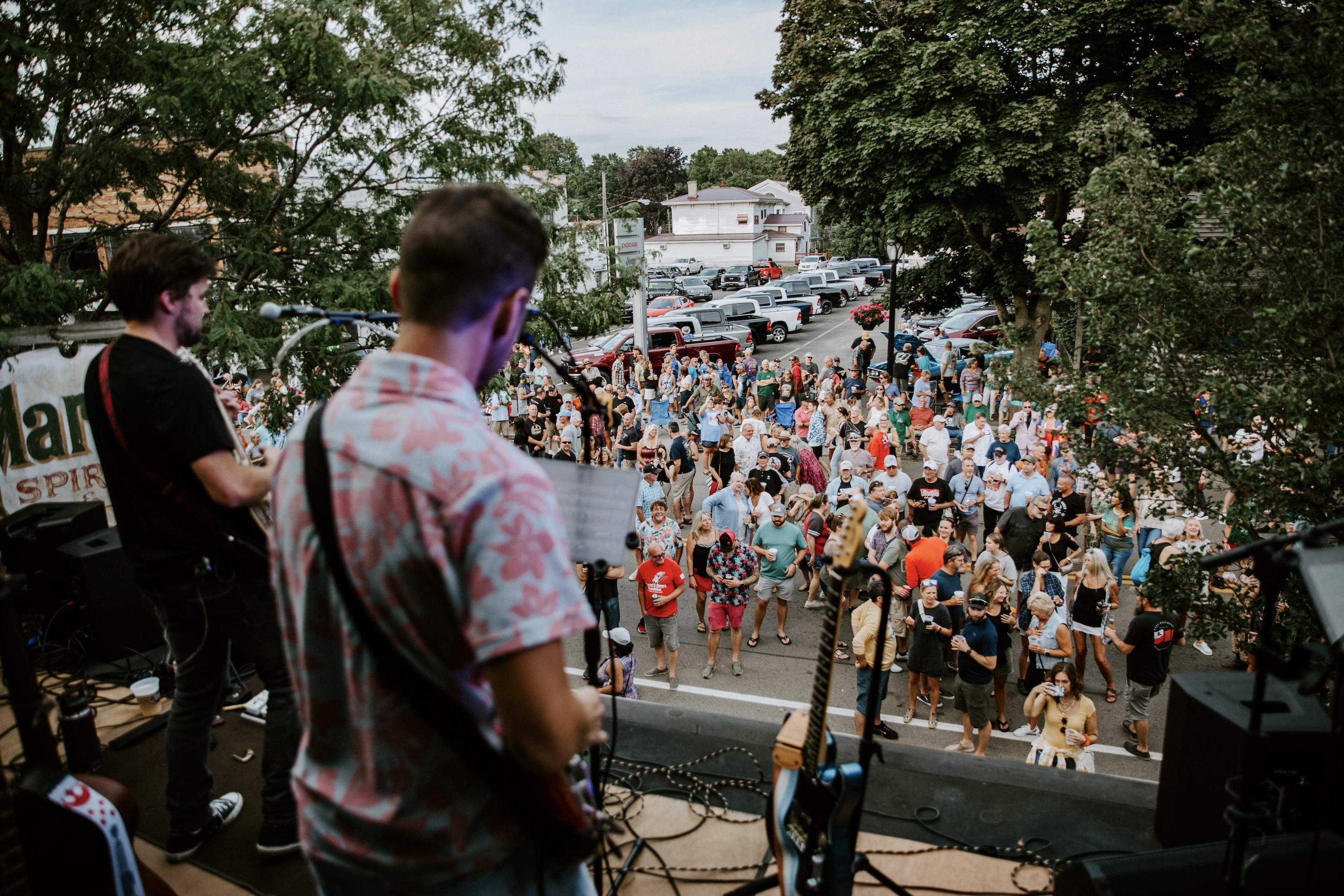
At 4:30pm the pre-race ceremonies began, the National Anthem was sung, and all the cars taking part in the Tribute Laps were in place. At 5:30pm the SVRA Grand Prix Race Tribute Laps began. Franklin Street was lined with excited spectators of all ages. The street party came alive with the roar of race engines, and everyone was treated to multiple laps of countless beautiful sports cars. After the laps were complete the streets stayed closed as the party continued full speed. Maria’s Tavern on Franklin Street featured the band The Variables, playing on a rooftop in front of a throng of happy festival goers. By 8:00pm the Sherriff’s Department dispersed the crowd in orderly fashion and Franklin Street was open again for normal traffic…until next year.
The 2024 Watkins Glen Grand Prix Festival was once again a huge success. You’d never think the previously mentioned schedule changes ever occurred. The streets were jammed with sports car fans and enthusiasts, and more importantly, fans of the festival. They, like myself, will never miss it. I’m already looking forward to 2025. And word has it that Porsche will be the featured marque! Make your plans now! For more information on the festival, please visit the Watkins Glen Promotions website at www.watkinsglen.com and the festival website at www.grandprixfestival.com. The photographer who supplied the lovely photographs for this article is Molly Batrowny (@molly.b_photographs on Instagram). See you all next year!
Coming back to the blog in 2025 will be a steady stream of book reviews. I tried this in 2020 during the lockdown and enjoyed it. So, be on the lookout for some great reading suggestions, and titles to add to your racing book collection.







 TJ - vintage & historic racing coverage