‘Miscellaneous Ramblings’ for June

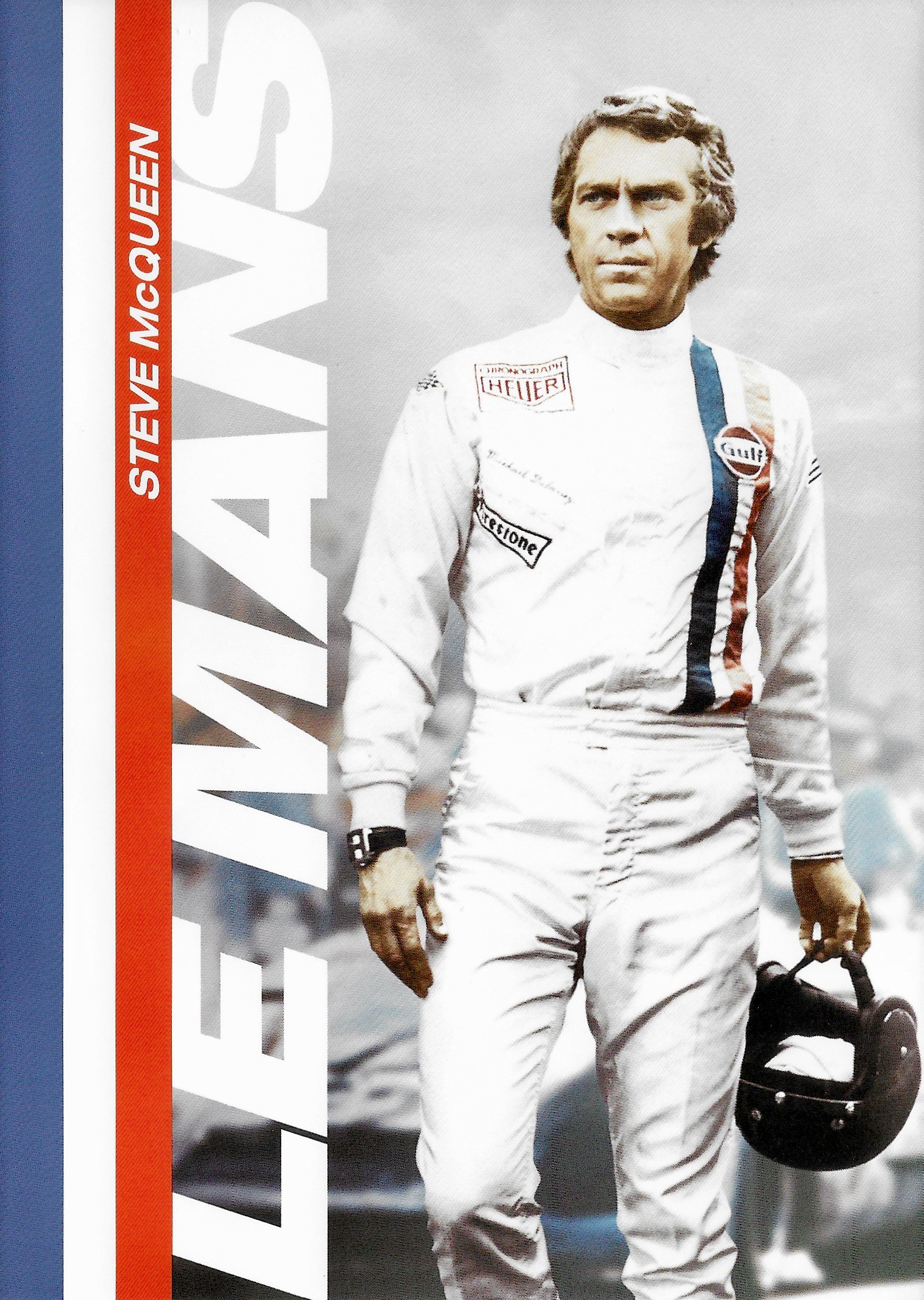
Le Mans starring Steve McQueen – The best auto racing movie ever.

A Solar Production, Released June 23, 1971.

One of my yearly traditions as an auto racing enthusiast happens during the first few days of June. Having just experienced the excitement surrounding the Indianapolis 500, my attention automatically turns towards the 24 Hours of Le Mans. I, like many sports-car fans of my age, became hooked on the sport, and in particular this race and endurance racing in general, through the movie Le Mans, starring Steve McQueen.

In my opinion it is simply the best movie about auto racing ever made. It’s a story about the race, the racing culture, and the race car driver. Considered a box office flop after its release (June 23, 1971), it quickly evolved into a cult classic. So many of the racers I’ve come to know in the vintage racing circles, and racing fans in general, point to this film as their inspiration and source for their love of the sport. 

The movie was filmed during the 1970 24 Hours of Le Mans, and then for weeks afterward with many drivers from the race. Despite the production challenges and set-backs McQueen experienced in the making of the movie, the result is a perfect portrayal of the sport and the essence of endurance racing. Steve McQueen stars as Michael Delaney, an American driver for Team Gulf Porsche. Some may characterize the film as a docu-drama, which very well may be the best description. What I appreciate most about the film is that it’s not bogged down with false storylines unrelated to the message but is a showcase for the passion of driving and for those who do it well. 

As the film begins, we see Delaney arriving at Le Mans, along with scenes of early morning race preparations around the track by organizers and of fans who have camped out for the 24-hour endurance classic. The narrative begins as drivers and crew members prepare the cars on the grid for the start. In the background you can hear the public address announcer providing vital information on the history of race, along with a rundown of the top qualifiers. Michael Delaney drives the #20 Gulf Porsche 917. He, along with his Porsche teammates will pitch battle with Team Ferrari. The countdown to the start is highlighted by Delaney sitting alone in the cockpit, with his heartbeat increasing steadily until the flag drops for the start. The first lap footage is fantastic, highlighted with the beautiful music soundtrack by Michel Legrand.

In a secondary storyline, Delaney has an uneasy connection with a lady who is attending the race the year after her husband, a Ferrari driver, was tragically killed in an accident that involved Delaney. The driver she’s with this year is also involved in a serious accident. Coincidently this incident also takes Delaney out of the race. Later, in the quiet of his motorhome, as she is trying to cope with all this, trying to understand the mindset of racers, she asks him, “When people risk their lives, shouldn’t it be for something very important? What is so important about driving faster than anyone else?” After a moment’s pause Delaney responds, “A lot of people go through life doing things badly. Racing is important to men who do it well. Racing is life, anything that happens before or after is just waiting”.

That’s it right there. The racer’s mindset, put into words, perfectly. 

Shortly afterwards, Delaney is asked by the Porsche manager to step in and finish the race in a different team car. In a thrilling last lap battle he holds off the Ferrari of his rival, Erik Stahler, enabling his teammate and Team Porsche to win. This movie epitomizes the passion of racing. Steve McQueen’s portrayal of Michael Delaney captures the inner calm and discipline needed to manage and temper the intensity of a racer.

Throughout my time covering vintage racing events I’ve had the pleasure of meeting and speaking with four of the drivers from the 1970 race: Brian Redman, Vic Elford, David Hobbs, and Derek Bell. Each when asked said that McQueen was a tremendous driver and could have been very competitive had he chose to pursue a racing career full-time. We’ll never know, but at least we have this classic to enjoy year after year. For those who may never have watched it, you’re in for a treat.

TJ

Posted in Auto Racing, Le Mans, Movie Review, Steve McQueen, Writing | Tagged , , , , | Leave a comment

Archive Flashback – May 2020 ‘A.J. – The Life of America’s Greatest Race Car Driver!’

There is no greater race in the world than the Indianapolis 500. The pre-race festivities giving honor and tribute to our fallen heroes on Memorial Day weekend fill our hearts with pride and gratitude. Finally, the singing of the traditional song ‘Back Home in Indiana’ sets the stage for the most famous words in racing, “Drivers Start Your Engines!”

This year Josef Newgarden piloted his #2, Team Penske, Dallara DW12-Chevrolet to a thrilling win for the second year in a row. The first back-to-back winner in twenty-two years. To honor the Indy 500 I thought we’d look back to my Vintage Racing Bookshelf review from May 2020. Enjoy! TJ

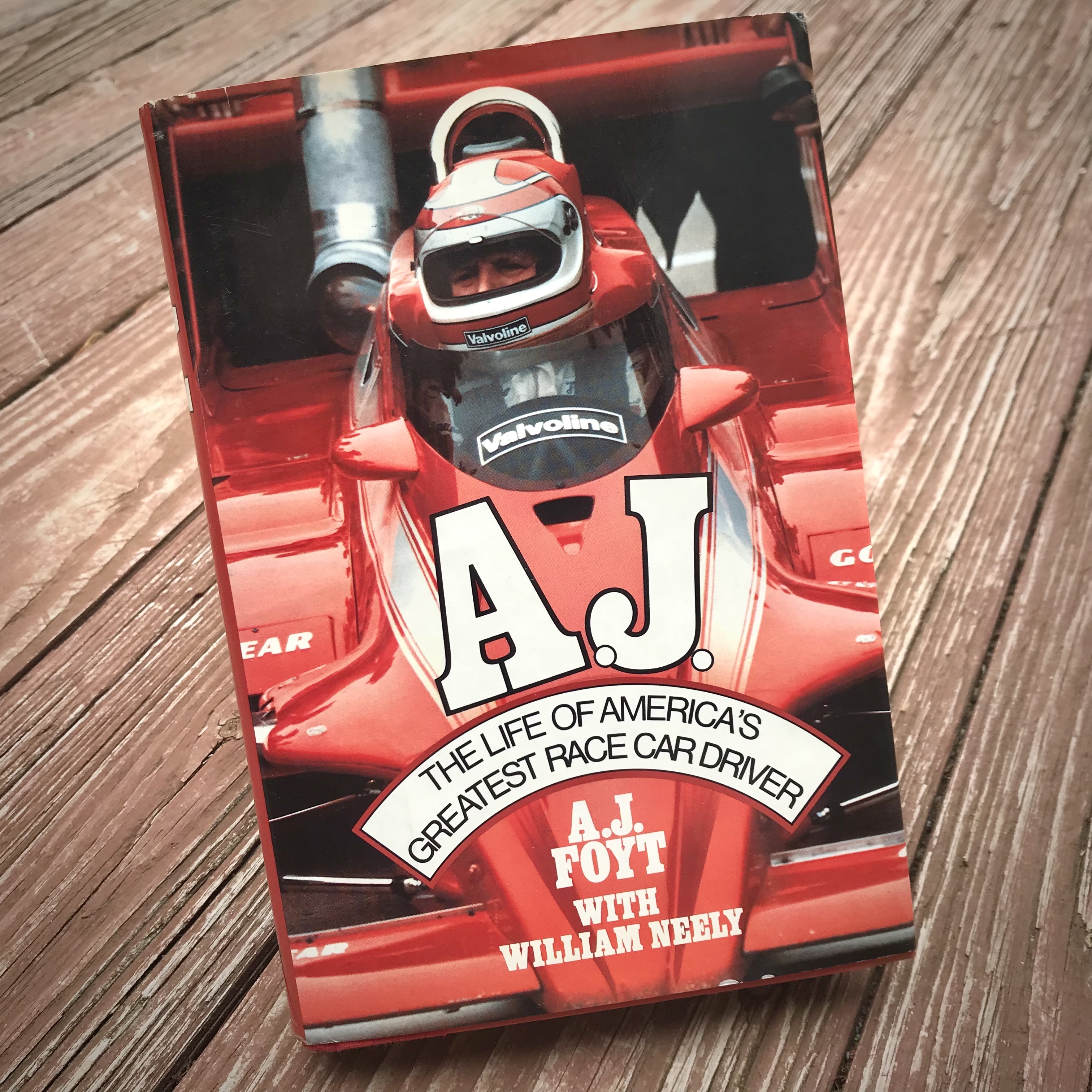
A.J. – The Life of America’s Greatest Race Car Driver

By A.J. Foyt with William Neely; Publish Date: 1983; Publisher: Times Books, Hardcover, 234 pages

It’s Memorial Day Sunday 2020, and for as long as I can remember I’ve planned my weekend, and this day in particular around the Indy 500. It’s something my lovely wife has accepted and put up with over the years. But this year feels a bit hollow and empty knowing that the greatest race in the world has been postponed…not for a day or two because of rain, but because of the Covid-19 Pandemic. It’s crazy and uncertain times we live in for sure.

That being said, I felt that the fifth book in my review series should honor the Memorial Day classic, so I’ve chosen A.J. – The Life of America’s Greatest Race Car Driver, by A.J. Foyt with William Neely.  The name A.J. Foyt is synonymous with the Indianapolis Motor Speedway and the Indy 500. He was the first of the 4-time winners of the race. Drivers Al Unser Sr. and Rick Mears later joined that exclusive club. A.J. Foyt also holds the distinction of being the last person to win the race in a front-engine roadster, and is the only driver to win the Indy 500 in both styles of car (Front engine roadster: 1961 and 1964, rear-engine: 1967, 1977).

This is a unique autobiography, in that it does not chronicle in detail his numerous race wins and championships, but instead focuses mainly on what it took to achieve these successes. A.J. Foyt tells us about his family, the relationship with his father, his determination to win and his undying competitiveness. The reader is swept through the book with his numerous and often humorous anecdotal stories, describing what life was like on the climb to the top. What is abundantly clear is that A.J. Foyt was relentless in his pursuit of wins, championships and the ultimate prize, the Indianapolis 500.

I was fortunate to see four Indy 500 races in the 80’s (1980-1983). Though A.J. Foyt did not win any of those, he received by far the loudest and most lasting applause during the pre-race introductions. He sat on the outside of the front row in 1981 and 1982. It was a thrill to be able to see him race at the famed speedway.

I highly recommend A.J. – The Life of America’s Greatest Race Car Driver.  It’s a clear and candid portrait of a racer driven to achieve greatness. I’m so glad I found this book at my local used book warehouse. I knew my collection wouldn’t be complete unless it included a book about the one and only A.J. Foyt.

TJ ….2020

Posted in Auto Racing History, Book Review, Indianapolis 500, Writing | Tagged , , , , | Leave a comment

Archive Flashback – April 2015 ‘The Power of Pink!

Let’s look back in the archive for a spotlight piece I wrote about Jeff Wright’s 1978 Chevron B45, which appeared in the April 2015 edition of Victory Lane Magazine. It was a pleasure to speak with Jeff and his wife Eve about this special car and its unique lineage. Enjoy!  TJ 

The Power of Pink! – Jeff Wright’s 1978 Chevron B45

Victory Lane Magazine, April 2015, Vol. 30, No.4; September 2014, SVRA Heacock Classic Gold Cup Historic Races @ VIR. Story and photos by Terry Johnsen

What’s not to like about a 70’s era, pink race car?! Especially, a pink race car with an interesting story to tell. So, while covering the 2014 SVRA Heacock Gold Cup at VIR, it didn’t take long for me to find my favorite car of the weekend. As soon as it passed by for the first time, I knew I had to find out more about it.

This 1978 Chevron B45 FA (Chassis #4), is owned and driven by Jeff Wright. On Sunday morning I spoke with Jeff and asked him about his pink beauty. He began by telling me he had always wanted a Chevron, and purchased the car in 1998 from Simon Hadfield in the UK. Simon is well known for his restoration craftsmanship. At the time of purchase, the car was completely disassembled. Jeff then flew the car over to the States in three crates. Progress on assembling the car eventually stalled. He had other cars and projects that slowed the process. Jeff said he realized it was wrong to have the car sitting and not assembled, so he refocused his efforts to get it done. He completed everything but the installation of the electrics, fire system, and fuel cell. He turned to the experts at Comprent Motor Sports/Road Racing Preparation & Fabrication, in Athens, Georgia for assistance. Once those items were installed, Jeff proceeded to finish the car. He said it has been easily 20 years since the car had competed, and the Gold Cup weekend was its debut.

Before discussing further the current state of the car, Jeff went back in time and told me a little history about it. Fred Ophert, of the UK originally owned chassis #2 & #4. There were only four built that year. Ophert ran the cars in the 1978 SCCA Formula Atlantic Championship. Keke Rosberg (Finland) drove chassis #2, and Eje Elgh (Sweden) drove #4. At the Lime Rock event, Rosberg crashed heavily. Elgh stood aside and allowed Rosberg to compete in #4. Keke put it on the pole and finished 4th. Rosberg drove the car off and on, mainly in practice and development, ultimately going back to chassis #2. Later, Arturo Merzario drove the car in the Canadian Labatt’s Series in Quebec. Davina Galica then drove the car in Hamilton. After the Labatt Series finished, the car went back to Chevron and was refettled for a race in Macau. Rosberg flew out to drive the car, but due to a coming together on the track, both team cars did not finish the race.

Jeff Wright, 1978 Chevron B45 Formula Atlantic, Chassis #4

The car then went back to Chevron and was purchased by Jim Crawford. He raced the car in the British Formula Atlantic Series, taking the title in 1979. Crawford then ran the car in the Aurora AFX Championship Series, which was basically a “run what ya brung” series. Impressively, Crawford won a race at Oulton Park that was run in the rain, and against some formidable competition. Later, Crawford sold the car to Vin Mulkey of Chevron. It then changed hands a few times and ultimately ended up in the possession of Simon Hatfield. Jeff brought the 1978 Chevron B45 (chassis #4) back to the US and has restored it to the 1978 specifications. That includes the vivid pink livery with the EXCITA (condom company) logo brand, which made the car (then and now) very distinguishable from the other competitors.

Jeff’s wife and Team Manager, Eve Wright, described the difficulty of finding the right pink color for the car. The trick was to use color chips from nail polish and lipstick manufacturers to nail down the closest comparison. From there, the paint was matched perfectly. Also, through intensive research, the correct size and style of numbers were found for the car. One of the last hurdles has been to find the period-correct logos for the SCCA, CASC, and Champion Spark Plugs.

Jeff described their operation as a family affair. He and his wife and sons are a real close-knit team. Together they have been racing for almost 40 years. Originally from Scotland, they lived for thirty years in Canada. There, Jeff became the Canadian FV Champion in 1977 and then Sports Racing Champion (in a Lola 492) in 1980. Currently, they reside in Wilmington, NC.

This weekend, the 2014 SVRA Heacock Gold Cup, is the first time out for the newly assembled car. It serves as a shake down weekend of sorts. Jeff expressed that he was a bit tentative to fully explore the car’s limits, but that so far it has no vices. He added that it brakes brilliantly and accelerates very well, and the balance is very good. He said he doesn’t know what it’s like on the limit yet. He also noted that later other refinements are to be sorted, such as the suspension ride height and camber. For now he’s content with firing up the Cosworth BDD engine, and taking the car through its paces, one step at a time.

On a final note, Jeff recently spoke to Simon Hadfield, who pointed out that this car is particularly unique in that it raced in North America as a works car (Opert Racing) and then later in Macau and the UK as a works car (Chevron).  Simon expressed that he didn’t think this was very common.  He noted that most FAs exported to North America stayed there.  Now Jeff and Eve have returned it to North America where it all began. I’m looking forward to its further development in 2015.

TJ 2015—————————————————

Posted in Auto Racing History, Photography, Victory Lane Magazine, Vintage Auto Racing, Writing | Tagged , , , , , | 3 Comments

‘Miscellaneous Ramblings’ for March

Carlos Sainz is on the move!

Before the 2024 Formula 1 season got underway it was learned that 7-time World Champion, Lewis Hamilton, would be moving to Ferrari beginning in 2025. That’s big news. But an even bigger story for the remainder of this season will be where Carlos Sainz finds himself for next year. He is certainly making his presence felt, from his third-place finish in Bahrain, to his dramatic win in Australia. Dramatic in the sense that he was still recovering from an emergency appendectomy just prior to the second race of the year in Saudi Arabia. I realize for Ferrari it was a huge move to get Hamilton for 2025, but I think Lewis may be replacing the wrong driver. It’s just my opinion, but from what I’ve seen of the two Ferrari drivers, I just like Carlos’ style and his race craft better. I feel it’s his controlled aggression and tenacity that allows him to get the best out of his car. Ferrari has upped their game in overall performance this year, and Carlos is aiming to use that to ‘show his stuff’, earning earn a top spot with a new team in 2025. Could it be at Red Bull alongside Max Verstappen? Or maybe at Mercedes, replacing Hamilton as the lead driver. Could McLaren be interested? We shall see. It’s going to be fun to watch.

IMSA and a Classic 12 Hours of Sebring

The overall win of the 72nd running of the Mobil 12 Hours of Sebring boiled down to a titanic battle between two teams and their drivers in the final minutes. Veteran driver Sebastien Bourdais, piloting the #01 Cadillac V-Series.R for Cadillac Racing held a slim lead over rising star, Louis Deletraz, in the #40 Acura ARX-06 for Wayne Taylor Racing/Andretti Global. As the clock ticked away and the laps drew down to the checkered flag, both drivers came upon lapped traffic. The ensuing final laps were a thrilling display of racing in its purest form. Bourdais did his best to fend off numerous overtaking maneuvers by Deletraz, but radioed his crew that he was losing grip. Finally, Delatraz made a daring move, but not without a fender banging defensive challenge by Bourdais. Once Deletraz secured the top spot he was able to hold on for the dramatic win by just .0891 over Bourdais. This was the first win for the new team partnership between Wayne Taylor and Michael Andretti. This just may be the spark that sets the team on the winning trajectory for the remainder of the year. I certainly hope so.

Has IndyCar begun their season yet?

IndyCar needs to reconsider their schedule in the years to come. The rest of the racing world seems to be leaving them in the dust, and even more hurtful, out of the headlines. By the end of March, Formula 1 has had three races, each with great storylines. IMSA has had their two marquee endurance events of the year, Daytona and Sebring. Each race featuring huge fields and an abundance of manufacturer participation. NASCAR has had seven races, each one an exciting contest, with literally a new winner every week. But so far, IndyCar has produced a snoozer in St. Pete and an equally unimpressive non-championship event at Thermal race club in California. Their next race isn’t until April 21st. It’s hard to compete with other racing series when there’s no momentum to the season. Their viability as a relevant series depends on it.

TJ

Posted in Auto Racing, F1, IMSA, Writing | Tagged , , , , , | Leave a comment

‘Miscellaneous Ramblings’ for February

Lewis Hamilton to Ferrari in 2025

The month of February was not even 24 hours old when we learned that 7-time F1 World Champion Lewis Hamilton will leave Mercedes and drive for Ferrari, beginning in 2025. Some have labeled the move as a ‘shocker’. But I for one saw it as inevitable. It was just meant to be. All the signs were there; he’s nearing the end of his career, he’s still driving at an elite level, the Mercedes car just hasn’t had the dominance and has struggled with pace in recent years, Red Bull and Max Verstappen don’t appear to be slowing down, and most importantly…it’s Ferrari! The most storied marque in racing! I can’t think of a more perfect ending to his career than to get his eighth world championship, the most all-time, driving the famous Italian red car with the screaming ‘tifosi’ cheering him on to the title. Go Lewis!   p.s…in today’s first and second practice rounds of the Bahrain Grand Prix weekend, Lewis has led the way and is on top of the charts. Who knows, maybe he has one more charge in him with Mercedes. I certainly hope so.

F1’s ‘Drive To Survive’ and the Christian Horner saga

Talk about timing. As lead-up to the 2024 Formula 1 season, Netflix launched the sixth edition of ‘Drive To Survive’ on February 13th. This series has set the standard for sports documentary dramas. The newest 10-episode edition covers the 2023 F1 season and all the intra-team drama, along with following the season long battle for points between teams in the Constructors Championship. Leading into this season the unfolding drama in Formula 1 centered on Red Bull Team Principal, Christian Horner, and the allegation again him of some sort of impropriety with a female colleague. No details have ever been disclosed, yet it was announced yesterday, Wednesday, Feb.28th, that he was cleared of all charges, just as the 2024 season is about the begin in Bahrain. One can only imagine that this will be a lead story for next year’s ‘Drive To Survive’. Horner has featured predominately in each of the six seasons, and at times has shown a prickly and cocky demeanor. It’ll be interesting to see how the writers and producers at Netflix weave this potential bombshell into the 2024 story.

NASCAR Starts Its Season

The NASCAR Cup season is well underway, and what a start it has been! William Byron won the Daytona 500 by an eyelash over his teammate Alex Bowman. It was an extremely popular win, with Byron well on his way to becoming an elite driver. This was his 11th Cup Series win, and he’s only 26 years old. I anticipate there being many more wins in his career before he calls it quits. Fast-forward one week in Atlanta and Daniel Suarez wins in a thrilling three-wide photo-finish over Kyle Busch and Ryan Blaney. Unbelievable! It was Daniel’s second Cup win and first on an oval. 2024 is off with a bang, with only 34 races to go!  Buckle your seatbelts!   p.s….the season actually began on February 4th with the running of the Busch Light Clash in the LA Coliseum. This was the last year of the contract for LA to host this popular non-points event. I certainly hope it goes back to Daytona where it began, and they establish the Speedweeks tradition that had worked so well in the past. The LA experiment failed.

TJ

Posted in Auto Racing, F1, Motor Racing, NASCAR, Writing | Tagged , , , , , , , , | Leave a comment

‘Miscellaneous Ramblings’ for January

Andretti F1 snub

Earlier today it was reported that the FOM (Formula One Management, F1 teams basically) declined, rejected, refused the entry application of the Andretti Formula Racing LLC to join the Formula One grid. Their statement included nonsense to the effect that they didn’t believe the entry would be competitive. That almost made me laugh out loud when you consider over half the grid of 20 cars in each F1 race has not a prayer to win. No, this is all about money, greed, and snobbery. I hope Michael Andretti and his group (to include General Motors) turn their sights on the WEC (World Endurance Championship) and go win the 24 Hours of Le Mans outright. I hope they expand their highly successful portfolio of racing series involvement and go NASCAR racing. Wouldn’t it be nice to see the Andretti name win the Daytona 500 again, like Mario did in 1967. F1 damaged their credibility with this decision. Had it not been for the highly popular Netflix series ‘Drive to Survive’, with its manufactured drama, their popularity would be considerably diminished. Because, in reality, the actual races are usually snoozers. 

IMSA Rolex 24 botched finish

The sports car season got underway last weekend in Daytona with the ‘twice-around-the-clock’ endurance classic, the Rolex 24. IMSA’s ‘Super Bowl’ kicked off the year in grand style. 59 cars took the green on Saturday (1/27), representing four classes (GTP, LMP2, GTD Pro, and GTD). It was an action-packed race that saw the Porsche Penske Motorsports (#7) Porsche 963 take the checkered flag, with drivers Dane Cameron, Felipe Nasr, Matt Campbell, and Josef Newgarden. One small detail about the finish…they didn’t go 24 hours. Unfortunately, human error stepped in, and the checkered flag was waved one lap too early. The winning time was 23:58:24. Race fans on social media went berserk. Some even wanted a do-over if you can imagine that. IMSA later came out with a statement admitting the error. Thankfully the rulebook has a clause that covers such things, and the results are final. These types of mishaps have happened before, and this probably won’t be the last. But could it be time for race series to consider alternative safeguards to be put in place to eliminate such errors. This was the first race of the year, imagine if this was a battle for the championship in the last race of the year.

Netflix NASCAR show

The new Netflix series ‘NASCAR: Full Speed’ debuted last night (1/30). The show features star drivers: Ryan Blaney, William Byron, Ross Chastain, Denny Hamlin, Bubba Wallace, Kyle Larson, Christopher Bell, Joey Logano, and Tyler Reddick in their quest for the 2023 NASCAR Cup Championship. It includes amazing racing footage, along with fascinating behind-the scenes storylines. I’ve watched one episode so far and it’s amazing. I highly recommend it!

TJ

Posted in Auto Racing, F1, IMSA, NASCAR, Writing | Tagged , , , , | 1 Comment

VRG Turkey Bowl @ Summit Point

Victory Lane Magazine – January 2024: Volume 39, No.1

Summit Point Motorsports Park, Summit Point, WV, November 17-19, 2023

Story by Terry Johnsen

Once again, the vintage racing season has drawn to a close. In general sports terms that conjures up thoughts of ‘the grand finale’, the fantastic finish that crowns a champion, or the gala event with all its bells and whistles. The fine folks of Vintage Racer Group (VRG) for years have chosen to take a different path to commemorate the end of their season. The Turkey Bowl at Summit Point Motorsports Park, a week before Thanksgiving, is a race meeting to savor the fun and comradery of fellow racers and friends one last time. Like a collective deep breath to appreciate each other and their shared love of racing competition.

I asked John Wood, current VRG President, what makes the Turkey Bowl the Turkey Bowl? He thought for a moment and said, “It’s a low-key event, it’s as much about the people as the cars. It’s a social thing, getting the cars out one more time before the snow flies, and to hang out with your friends.” And in that spirit VRG and their members will come together on Saturday night to celebrate a great year, give out a few awards and satisfy their palate with a good old-fashioned chili cookoff.  John went on to say that 2023 was a good year for VRG, with increased participation at every event, and that financially they’re in solid shape. Looking forward John told me that the 2024 VRG will feature the same dates and same tracks as this year. Which is a welcome sign of stability for any racing series. 

A bit of sadness played a part in the 2023 season, as two of VRG’s nine original founding board members died this year. First, Brad Marshall passed away mid-year. John noted that Brad was a driving force to get VRG started in 2004, with his focus on safety. Brad was the one who said, “let’s do this!” Then in late August, Tivvy Shenton passed away. John said “Tivvy was the one original board member that was most continuously involved from day one and remained active through this year.” VRG has come a long way, supported by the solid leadership of its founders. Their beloved memory was on the minds of all Turkey Bowl participants this weekend. 

Five race groups defined the on-track activity for the weekend: Group 1 (VRG Small Bore), Group 2 (VRG Open-Wheel), Group 3 (VRG Medium/Big-Bore), Group 4 (Modern Sports/GT), and Group 5 (Legends). The weekend schedule was a straightforward and simple affair. Friday consisted of registration, tech inspection, and some limited practice. Saturday’s activity was pure racing, beginning with a warmup session, followed by a round of qualifying, then a race for each group after the lunch break. Sunday’s activities featured three special ‘Festival’ race events.

Group 1 held their race just after the lunch break. It was basically over before it began, with two separate black flags (the first after lap one and the second after lap four) ultimately stopping the race. Setting the pace from the drop of the green flag was Andrew Moore (#79) in his 1964 Austin Healey Sprite. He was followed closely by Jesse Darrow (#51, 1965 Triumph Spitfire) and Mark Gobble (#59, 1959 Elva Courier). It was in this order they finished race when it was called, due to multiple cars off-track.

Group 2 then took to the track and ran a clean race throughout. Josh Lewis (#812) stormed away from the field in his 1985 Lola T598. His fastest lap of the race was an impressive 1:19.496. Steve Byrne (#23, 1984 Swift DB1) and Leon Hodges-Austin (#45, 1978 Zink Z10 C) finished second and third respectively, drawing away from the pack and running by themselves for much of the race. The hottest battle in this group was for fifth place, waged between Dennis Austin (#5, 1976 Zink Z10-A) and Andrew Graham (#7, 1986 Van Diemen 1600), finishing in that order.

Group 3 presented a huge field of 37 cars for the race. Cord Kisthardt (#69) started on pole in his 1968 Chevrolet Corvette and cruised to an easy victory. But early on he withheld a serious challenge by second place runner, Todd Reid (#61, 1995 Honda Civic DX), who even took fastest lap on the 4th circuit of the race. During laps 3-5 the two drivers were nose-to-tail. Lap six is when Reid’s car began to fail him, and he eventually fell through the field out of contention. James Glass (#11, 1965 Chevrolet Corvette) inherited second spot, while Scott Krueger (#22, 1972 Porsche 914-6) improved to hold on to third position. Drivers finishing in positions 4-23 were a lap down, while the rest of the cars were further afield.

The race for Group 4 was a bit of a headscratcher, in terms of the official results posted by MyLaps. Their listing had Qais Musmar (#34) winning in his 1973 Porsche 911, followed by Andrew Mistak (#17, 2013 Chevrolet Camaro TA2) in second and Thomas Beverly (#4, 1992 Honda Civic) in third position. This writer was in the scoring booth lap counting, watching Mistak (#17) dominate the field, building a healthy gap till lap 8 when he pulled in for a brief stop. He reentered the race in third position, with Musmar (#34) in the lead and Graham Fuller (#22, 1992 Toyota Tercell) in second position. It stayed that way for a few laps until a black flag came out on lap 11 because Michael Ballo (#135, 1974 Porsche 911) spun and collected the inside retaining wall on the front stretch, losing his front bumper along with other assorted parts strewn all over the track. The entire field was then brought onto pit lane while the clean-up was underway. When the cars were released to resume the race, the order passing the start-finish line was #22, #17, #4, #0, and Musmar (#34) in fifth position. When they took the green flag the next time by, Mistak (#17) was in the process of passing Fuller (#22) for the lead. On lap 17, Beverly (#4) passed Fuller (#22) for second. At the checkered flag Mistak (#17) was the winner, and class of the field. I had Musmar (#34) moving up to fourth position, last car on the lead lap. My old-school lap-counting process in usually spot-on, so I’m at a loss as to why there’s a discrepancy in the transponder readings, but there you have it.

Then came group 5. If you’d put your money on #8 you could have won a bunch of money, for there were plenty to pick from. The winner of the contest was Tyler Hughes (#8h) in his 1934 Ford Legend. For much of the race he was followed closely by Mike Weddell (#8m, 2014 Legend Ford) and Connor Weddell (#8c, 2014 Legend Ford). Ultimately David Markham (#10, 2014 Legend Chevy Coupe) claimed second position with Mike Weddell (#8m) settling for third spot. A great day of racing was in the books, now it was time for some chili!

The highlights for Sunday’s activity centered on the three Festival Events. First on track was Group 2 for the Formula Festival race. Steve Byrne (#23) cruised to the win in his 1984 Swift DB1. He had Leon Hodges-Austin (#5, 1978 Zink Z10 C) in his mirrors throughout the race but provided no serious threat, even though Leon captured the fastest lap of the race with a 1:21.657. Tim Hannen (#0, Ford Hawke DL17) rounded out the podium in third.

Next up was the Vintage Festival, featuring cars from Group 1 and Group 3. An incredible field of 54 cars took the green flag. Todd Reid (#61) set the pace in his 1995 Honda Civic DX. He secured the fastest lap with a 1:27.028 and went on to capture the win. James Glass (#11, 1965 Chevrolet Corvette) and Scott Krueger (#22, 1972 Porsche 914-6) put in strong showings, taking second and third finishes respectively.

Closing out the Sunday Features were the racers from Group 4 and Group 5 in the Modern Festival. Qais Musmar (#34) piloted his 1973 Porsche 911 in a close fought race for the win. He was followed across the line by Tyler Hughes (#8h, 1934 Ford Legend), 1.531 seconds back. Connor Weddell (#8c, 2014 Legend Ford) claimed a respectable third position.

The Turkey Bowl concluded as the sun faded on the horizon. Another successful VRG racing season finished, not as a grand finale, but as a satisfying get-together with friends before the first pesky winter snowflakes make an appearance. This may be a ‘low-key event’ as VRG President John Wood put it, but it’s also the perfect opportunity for everyone to savor the moment, give thanks, and to appreciate each other and their shared passion of racing. On to 2024!

TJ

Posted in Victory Lane Magazine, Vintage Auto Racing, Writing | Tagged , , | Leave a comment

Watkins Glen Grand Prix Festival/US Vintage Grand Prix Weekend

September in Watkins Glen, my favorite time of year. Once again the crew gathered for our yearly brush with racing history. We were very fortunate with the weather, in that it always rained where we were not. You can’t argue with that. It was a weekend to enjoy the sights and sounds of race cars, delicious food and beer, and the camaraderie of good friends. The following are a few photos from the International Motor Racing Research Center, the downtown street party known as the Watkins Glen Grand Prix Festival, SVRA’s US Vintage Grand Prix/Speedtour, and the Seneca Lodge Bar and Restaurant. Enjoy, we did! TJ….2023

On The Grid at IMRRC, 1924 Dundee Dodge.
Under the hood of a 1965 Shelby Cobra.
Lined up for the Grand Prix Vintage Festival is a 2009 Porsche Cayman.
This 1969 Corvette was one of many celebrating the 75th Anniversary of the marque.
1979 Crossle 35F (#414), 1977 Crossle 32F (#127), 1983 Lola T642 (#189).
NASCAR thunder. Rusty Wallace’s 1993 Pontiac Grand Prix.
2015 Ford Mustang (#48), 1971 Chevron B19 (#33), 2014 Radical SR3 (#46).
Finishing off the weekend at Seneca Lodge Bar & Restaurant.

Posted in Auto Racing History, Classic Cars, Photography, Uncategorized | Tagged , , | 1 Comment

The Charles Town Car Show, September 2nd, 2023

The Charles Town Car Show in West Virginia made such a positive impression on me in 2022 that I made sure to mark it on my calendar this year. It was a fantastic turnout, and seemed to be even bigger and more well-attended than last year! There were loads of beautifully-prepared roadsters, hot rods, and classic cars, along with a wide-variety of incredible food vendors. Combine that with a bright and sunny day, it resulted in a fun and memorable festival atmosphere for everyone. Here are a few snap-shots from my stroll along Washington Street. Enjoy. TJ….2023

1970 Chevy Chevelle
1956 Chevrolet 210
1932 Ford Coupe
1956 Mercury Medalist
1970 Dodge Charger 500
A car show isn’t complete without ‘The Batmobile’!

Posted in Classic Cars, Photography, Uncategorized | Tagged , | Leave a comment

VRG Jefferson 500 @ Summit Point

Victory Lane Magazine – July 2023: Volume 38, No.7

Summit Point Motorsports Park, Summit Point, WV – May 19-21, 2023

Story by Terry Johnsen

Gary Reed #16, 1969 Datsun 510

Just a short trip from the nation’s capital, nestled in the rolling hills of West Virginia, sits Summit Point Motorsports Park. The mid-Atlantic region of the United States loves their sports car racing. So annually, in the month of May, passionate sports car enthusiasts gather at Summit Point for the traditional Jefferson 500. 2023 marks the 28th running of the event. 

This year included a special feature with the inclusion of the Marlboro Motor Raceway Reunion. The gathering was hosted by noted Marlboro racetrack historian, Steve Lloyd. The link between Summit Point and Marlboro is significant, in that they each have served as the DC region’s ‘home track’ dating back to 1952 when Marlboro began their race activities. Marlboro eventually closed its doors in November 1969, just as Summit Point was making its mark on the racing scene. The racers instinctively moved their allegiance to Summit Point. When asked to describe the similarities between Marlboro and Summit Point, Lloyd chose the French phrase, ‘je ne sais quoi’, meaning he found it hard to accurately put it into words, but then added, with a smile, “it’s not the same feel, but pretty damn good”.

The Jefferson 500 is Vintage Racer Group’s marquee event, and each year it has gotten bigger and better. It’s a full week of activities for everyone. Tuesday began two busy days featuring the VRG Licensing School, along with registration, tech activities, and load-in of race trailers and equipment. Thursday got down to business with a full day of practice for all the group categories, along with school participants. The day concluded with a track walk.

Racing activities for the Jefferson 500 got underway Friday morning, May 19th, with timed qualifying sessions for all groups 1-6, finishing with a practice session for Group 7. The afternoon saw the running of the first sprint races, finishing with a Group 7 qualifying session. After track activities concluded, Steve Lloyd held an historical look-back at Marlboro Motor Raceway in the paddock classroom with his talk entitled, ‘Marlboro: The Mob, The Moolah, and The Madness’. It was a thrilling and insightful presentation. Vintage motor sport mainstay and reunion contributor, Bob Houston, described the reunion as fantastic! He said, “it was great to see people who hadn’t seen each other in over 20 years, sit down and talk”. He added, “I like the old saying…the end product of motor racing are race stories”. He summed it up perfectly.

Vintage Racer Group has long honored the history of sports car racing by featuring the names some of the great competitors of the past to identify their race groups. Names such as John Wyer, Briggs Cunningham, Mark Donohue, Phil Hill, Charlie Gibson, Lola sports cars, along with a nod to Marlboro Motor Raceway. The Sunday Enduro’s also pull from the legends of the sport with names such as Brian Redman, Dan Gurney, and Bill Scott.

Saturday afternoon was highlighted by the running of the feature races. First on the docket was Group 1 (Wyer Cup) for the IMSA RS – 2.5 Challenge. Steve Byrne (#3) was the class of the field driving his 1970 Datsun 510. It was a dominant performance which saw him capture the fastest lap of 1:26.592. Byrne captured fastest laps of the two sprint races as well. His main rival of the weekend was David Porter (#58) in a 1973 Ford Escort RS1600. He came second to Byrne in the feature event and the Friday sprint race. Porter found the top step of the podium in the Saturday morning sprint.

Next came the competitors of Group 2 (Cunningham Cup) for the Big Bore cars. Clarke Ohrstrom (#72) drove his 1971 BMW 3.0 CSL to victory, securing the fastest lap of 1:24.492 along the way. This was his best result of the weekend. Douglas Hagopian (#24), driving a 1974 Porsche 911 came in second, and bettered that by winning both of the sprint races.

Third on the schedule of feature events was Group 3 (Marlboro Cup) for Small Bore over 1.3L cars. Robert Andersson (#78) piloted his 1970 Vitesse Sports Racer for the win. He also claimed fastest lap with a time of 1:28.365. Mike Moore (#167) was right on Andersson’s tail in a 1962 Triumph TR4 finishing second. Moore also won both sprint races.

Next on track was Group 4 (Lola Cup) for Small Bore under 1.3L and Formula Vee cars. Will Thomas (#191) won the event behind the wheel of his 1965 Austin Cooper S. The fastest lap of the race was set by David Gussack (#188), driving a 1963 Triumph Spitfire. He dropped out at the midpoint of the race. But Gussack showed his pace earlier by capturing both Friday and Saturday morning sprint events. 

Immediately following, the cars and drivers of Group 5 (Donohue Cup) for Production and Specials through 1960 rolled out for their race. John Styduhar (#9) bested the field in his 1962 Triumph TR3B, which included taking the fastest lap with a time of 1:33.309. Styduhar battled with Vic Schuster’s (#57) 1957 Triumph AMBRO for first and second all weekend. Schuster took the win in the first sprint race, while Styduhar edged him out in the second sprint.

Later that afternoon saw the running of Group 6 (Gibson Cup) for Sports Racers and Non-FFCS Open Wheel cars. Brandon Weber (#8) rocketed his 2004 Carbir CS2 around the track, leaving the rest of the field to battle amongst themselves. Weber set a fast lap of 1:15.584, which was the top time of the entire weekend. He was in a class of his own, finishing a lap ahead of the second-place finisher. Weber swept the weekend sprint races as well.

The final feature race of the day was Group 7 (Phil Hill Cup) featuring the Formula Ford Challenge Series. The highlight of any VRG event is when the cars and drivers of Group 7/FFCS take to the track. It is extremely competitive racing, and with a stacked field anyone can win. 37 starters took the green flag. Scott Fairchild (#20), driving his 1978 Zink Z10 won the closely contested event, just ahead of second place finisher Doug Meis (#27) in a 1974 Lola T340. Third place finisher Chris Fahan (#70) captured the fastest lap of 1:25.594 in a 1981 Van Dieman RF81. 39 cars ran in the Saturday morning sprint race, won by Leon Hodges-Austin (#6), driving a 1978 Zink Z10 C. Stefan Vapaa (#97) won the Sunday sprint race with his 1969 Macon MR7.

The Sunday morning enduro events allowed the cars and drivers to stretch their legs one last time. Douglas Hagopian (#24) won the Brian Redman Enduro (Groups #1, #2, #6 closed wheel only) in his 1974 Porsche 911. David Biegert (#1) won the Bill Scott Enduro (Group #3, #4, #5), with his 1990 Mazda Miata. Doug Meis (#27) won the Dan Gurney Enduro (Groups #6, #7 open wheel only) driving a 1974 Lola T340. By early Sunday afternoon a dwindling field of drivers took to the track one last time for the All-Comers Sprints, but by then everyone seemed to have had their fill. Stuffed with lasting memories from another memorable Jefferson 500.

It’s these types of events that make vintage racing so attractive to the racing enthusiast. The Jefferson 500 is a fun event, a social event, a feel-good type of event. From this, old friendships are rekindled, and new connections are made. It brings me back to Bob Houston’s wise words, “the end product of motor racing are race stories”. For sure another wonderful chapter of race stories were written at this year’s Jefferson 500.

TJ – 2023

Posted in Victory Lane Magazine, Vintage Auto Racing, Writing | Tagged , , | Leave a comment